Key takeaways
The SAT Verbal section, now known as Reading and Writing on the Digital SAT, evaluates critical skills essential for college success, such as evidence analysis and text navigation. A strong performance in this section can significantly enhance your college application, making it crucial for aspiring students.
- The Reading and Writing section comprises two modules, each lasting 27 minutes, with a total of 54 questions covering literature, history, science, and humanities.
- Focus on mastering question types, such as transitions and evidence, rather than just grammar rules to improve your score.
- Reading and Writing accounts for half of your total SAT score, which ranges from 400 to 1600 when combined with the Math score.
- Avoid rushing through questions; take the time to understand the context and identify question types to prevent falling for trap answers.
Contents

The SAT Verbal section—now called Reading and Writing (R&W) on the Digital SAT—is more than just a grammar test. It measures how well you analyze evidence and navigate dense text quickly. These are the same skills you’ll use in college seminars and research papers. If you want to impress competitive schools, a strong verbal score is one of the best ways to do it.
What Are the Key Components of the SAT Verbal Section?
The Digital SAT’s verbal portion is officially titled Reading and Writing and consists of:
- Two modules, each lasting 27 minutes
- A total of 54 questions
- Topics drawn from literature, history, science, and humanities
- Both reading comprehension and grammar/editing questions
How the Reading and Writing Modules Are Structured?
Each module includes a mix of:
- Information and Ideas: Inference, central idea, evidence use
- Craft and Structure: Word meaning, tone, text structure
- Expression of Ideas: Transition logic, sentence placement
- Standard English Conventions: Grammar, punctuation, agreement
The test is multistage adaptive. Your performance in Module 1 determines whether Module 2 is easier or harder—which affects your final score.
How Does the Verbal Section Contribute to Your Total Score?
Reading and Writing makes up half of your total SAT score—scored out of 800. That score is then combined with your Math score (also out of 800) for a total score between 400-1600.
Why Colleges Value Strong Verbal Performance?
Strong verbal scores suggest more than vocabulary skills. They signal:
- The ability to comprehend academic texts
- Strong critical reasoning and logic
- Writing fluency—especially in grammar and structure
- Readiness for discussion-based courses and essay-heavy majors
“For example, the comprehension section of SAT, like you have to read the paragraph is probably something you have not read before and then understand and answer the questions, this is an important skill which is applied even in anything you will read in the future in college and even in life”
— u/Even-Ad-9930, Reddit
How to Prepare for the Digital SAT Verbal Section?
Legacy Online School helps students build the confidence and skills they need to succeed on the SAT® and ACT®. All lessons are delivered live online, with real-time support and feedback from qualified instructors who are fully invested in your progress. If you’re serious about improving your score, we’re here to guide you every step of the way.
Here’s what effective prep looks like in 2025:
- Use Khan Academy or Legacy Online School for adaptive practice by category
- Practice in Bluebook
- Track question types
- Aim to finish 1-2 minutes early per module to review
- Create a mistake log
What Strategies Can Help You Improve Your Verbal Score?
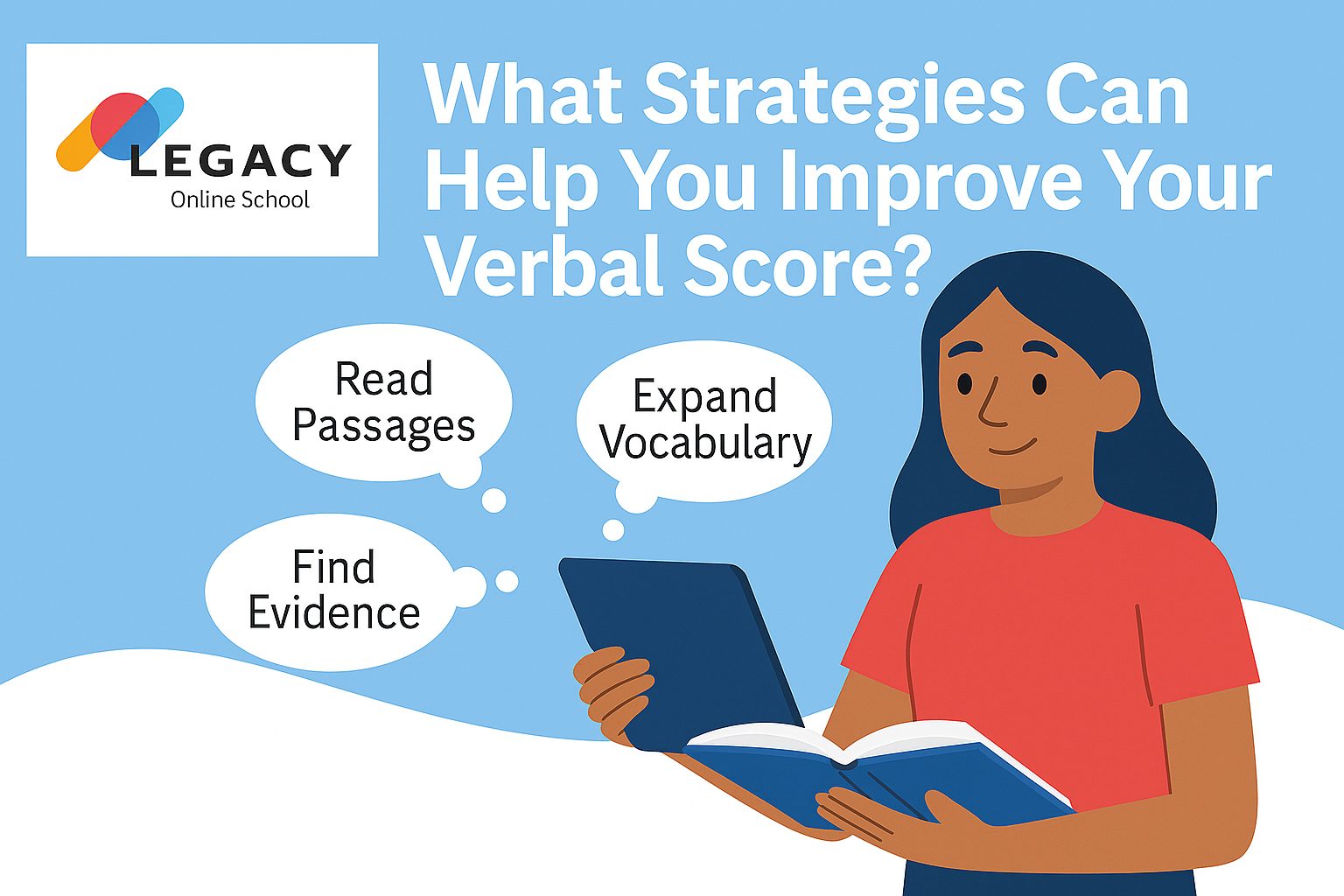
The top-scoring students almost always do these:
- Eliminate by logic, not feel—Every wrong choice has a reason
- Preview the question before reading if it’s grammar-based
- Look for contrast and causation in transition questions
- Read actively—especially when facing unfamiliar science or history texts
- Study transition categories (contrast, cause, continuation)
- Reread only when needed—don’t lose time on over-analysis
What Mistakes Should You Avoid in the Verbal Section?
One of the biggest mistakes is rushing through questions without fully understanding the context. The SAT often places key clues in surrounding lines. If you read only the sentence in question, you’re likely to miss the logical relationship or tone the test is asking you to identify. Students who rely on “gut feeling” or try to guess based on what sounds good often pick wrong answers that are grammatically correct—but completely off in meaning.
Another common issue is not identifying the question type before jumping to the answer choices. Each question is designed to test a specific skill. If you don’t slow down and recognize what is being tested, you’re more likely to fall for a trap answer that looks right but doesn’t do the job.
Many students also get tripped up by transition questions, especially when they rush past contrast or cause-effect relationships. The best strategy here is to cover the transition word and read the sentence without it—then ask yourself how the two ideas are connected before looking at the options.
|
Top Tips from Our Expert
|

Ana Lucía Torres, Senior Learning Advisor
Sources: College Board, Reddit