Key takeaways
Old SAT Subject Tests, although discontinued, remain valuable practice tools for students preparing for the Digital SAT or college-level courses. Utilizing these materials can enhance skills in specific subjects, providing a competitive edge in academic performance.
- SAT Subject Tests were standardized exams scored on a 200-800 scale, with a typical structure of 60-85 multiple-choice questions (College Board).
- Practicing with old Subject Test materials can significantly benefit students in STEM fields, especially for AP courses and pre-med tracks.
- The Biology Subject Test included two sections: Biology E (Ecological) and Biology M (Molecular), allowing students to focus on their strengths.
- Simulating test conditions, such as using a timer and avoiding calculators, can help build stamina and improve performance on the SAT.
Contents

Even though SAT Subject Tests were discontinued in 2021, they still offer serious value as practice tools—especially for students preparing for the Digital SAT or college-level coursework. If you’re prepping for biology or math, diving into old SAT Subject Test materials can sharpen your skills and give you a solid academic edge.
What Were SAT Subject Tests and Why They Still Matter for Practice?
SAT Subject Tests were standardized exams offered by the College Board in core academic subjects. They were often used to:
- Highlight academic strengths for selective college admissions
- Fulfill certain placement or language requirements
- Demonstrate mastery in STEM, history, or languages
How the Format of SAT Subject Tests Was Structured?
Each SAT Subject Test was a one-hour, multiple-choice exam scored on a 200-800 scale.
General structure:
- ~60-85 questions, depending on the subject
- No calculator allowed on most science or language tests
- Focused entirely on content knowledge—no essay or open response
- Strict time pressure (1 minute or less per question)
Which Subjects Were Commonly Offered and What Biology Covered?
The College Board offered 20 Subject Tests across five categories:
- Math: Math Level 1 and Math Level 2
- Science: Biology E/M, Chemistry, Physics
- English: Literature
- History: U.S. History, World History
- Languages: French, Spanish, Chinese, Latin, and more (with or without listening)
The Biology Subject Test came in two flavors:
- Biology E (Ecological): Focused on populations, ecosystems, and energy flow
- Biology M (Molecular): Emphasized cellular processes, genetics, and biochemistry
Students chose E or M at the start of the test and answered the corresponding 20-question section after a shared 60-question core.
How to Choose the Right Subject Test When Relevant for College Prep?
If you’re prepping for advanced science or STEM majors, it’s still useful to work through old Subject Test content—especially in these cases:
- AP Biology students can use Bio M practice to drill cell processes and lab data
- Pre-med track students benefit from Biology and Chemistry test logic
- SAT Math students gain from Math Level 2’s emphasis on algebra and trig
- Humanities students can sharpen literary analysis with the Literature Subject Test
“Do the ones you think you’ll do best on. If you don’t think you’ll do well (700+), don’t take the test”
Where to Get Real SAT Subject Test Practice Materials?
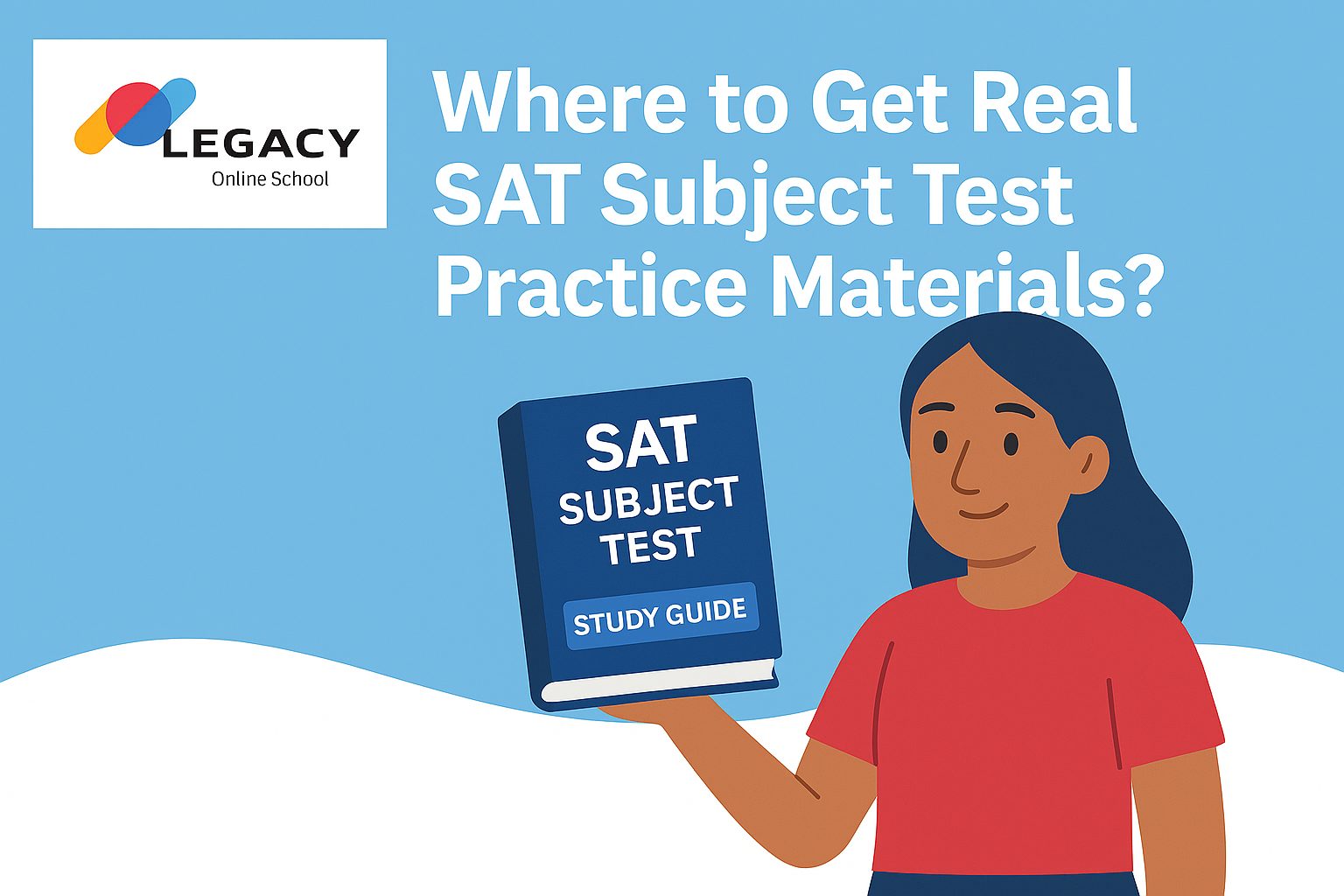
Official materials aren’t new anymore, but you can still find good ones to practice:
- College Board’s archived practice questions (saved by third-party platforms like TestPrepReview)
- Books like Barron’s SAT Subject Test Biology E/M
- YouTube walkthroughs from channels like Heimler’s History or Leah4Sci (for science content overlap)
How to Practice Effectively for the SAT Biology Subject Test?
Legacy Online School helps students build the confidence and skills they need to succeed on the SAT® and ACT®. All lessons are delivered live online, with real-time support and feedback from qualified instructors who are fully invested in your progress. If you’re serious about improving your score, we’re here to guide you every step of the way.
Even without the official test in circulation, Bio Subject Test practice helps strengthen your critical reading and data interpretation for science-heavy SAT and AP questions.
Here’s how to use it well:
- Take full practice sections under timed conditions
- Focus on graph and experiment interpretation, not just memorization
- Review vocabulary-heavy questions and group similar concepts
- Keep a mistake log: note missed topics and re-drill them weekly
Performance Tips for the SAT Subject Test Experience
Though you won’t take these tests officially anymore, practicing like you are can build real stamina.
Tips for simulation:
- Use a 60-minute timer for each full test
- Complete multiple-choice bubble sheets to simulate pressure
- Don’t use a calculator—even in math/science—unless the original test allowed it
- Score yourself using official answer keys and convert to the old 200-800 scale
What Additional Prep Resources Are Available?
For more in-depth prep, combine Subject Test materials with:
- AP exam prep books (Barron’s or Princeton Review)
- Khan Academy for foundational concept reviews
- Legacy Online School’s AP and SAT hybrid prep programs (live and on-demand)
|
Top Tips from Our Expert
|

Ana Lucía Torres, Senior Learning Advisor
Sources: College Board, Reddit