Key takeaways
AP Biology Unit 5 delves into the intricate mechanisms of heredity, emphasizing the importance of understanding genetics for future biological studies. Mastery of these concepts is crucial for students preparing for AP exams, as they form the foundation for advanced exploration in genetics and related fields.
- Genes are segments of DNA on chromosomes, and environmental factors can influence gene expression, affecting health and disease vulnerability (source: article).
- Understanding the difference between genotypes and phenotypes is essential for predicting genetic outcomes using tools like Punnett squares.
- Independent assortment during gamete formation increases genetic variation, allowing populations to adapt and evolve (source: article).
- Creating an organized study plan that includes diverse resources, such as videos and practice tests, enhances retention and understanding of genetic concepts.
Contents
Students gain detailed knowledge about genetics and genetic processes during the AP Biology Unit 5 since it investigates complex mechanisms of heredity.
The unit explores basic principles of heredity which control trait transmission between generations focusing on genetic elements like genes and chromosomes combined with different genetic alterations. Students taking the AP exams must deeply understand these crucial topics since they will serve as basic knowledge for next-level biological exploration.
What are the Key Concepts of Genetics in AP Biology Unit 5?
Understanding Genes and Chromosomes
Genes are segments of DNA located on chromosomes. Chromosomes are structures within cells that carry genetic information.
Gene expression faces effects from environmental elements such as nutritional intake, mental pressure, and chemical substances. Environmental factors produce alterations which either remain temporary or become permanent and affect both an individual’s health and their disease vulnerability.
AP Bio Unit 5 analyzes epigenetic regulation to demonstrate how genes interact with environmental factors in order to explain complex genetic expression and hereditary patterns. Understanding how the environment affects gene regulation remains essential for fields including medicine because they extensively explore gene regulatory changes caused by environmental factors together with evolutionary biology.
Exploring Genotypes and Phenotypes
Genotypes refer to the genetic makeup of an individual, while phenotypes are the physical expressions of those genes.
Dominant and recessive alleles contribute to the phenotypic traits of offspring. A trait that is governed by a dominant allele will manifest in the phenotype even if only one copy is present in a heterozygous individual. Recessive traits, on the other hand, require two copies of the allele (homozygous) to be expressed.
Understanding the distinction between dominant and recessive traits helps students predict the outcomes of genetic crosses and for employing tools like Punnett squares to visualize the inheritance patterns of traits.
Here is an example of a simple Punnett square that students can use when trying to predict outcomes of genetic crosses:
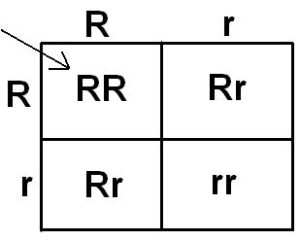
“One way to visualize the possible offspring of a cross between parent organisms is to use a Punnett square. This basic grid method is used to show all possible combinations of alleles and determine the overall frequencies of each genotype and phenotype.”
– Albert
Independent Assortment in Genetic Variation
Independent assortment describes how different traits separate from each other independently during gamete formation. The reproductive cells that fuse during fertilization produce genetic variation because different allele combinations form due to independent assortment.
The genetic diversity of populations increases through independent assortment because it allows organisms to adapt in evolutionary ways for survival. Researching linked genes enhances comprehension of genetic variations but introduces complexity to the study. The genes create possible genetic variation since they cluster on a single chromosome and are inherited together.
How to Study Effectively for AP Biology Unit 5 Heredity?
“Students with non-mechanistic conceptions of genetic phenomena (e.g., thinking of genes as traits or trait-bearing particles) often have more difficulty learning the underlying mechanisms of heredity.”
– Michal Haskel-Ittah and Anat Yarden
Creating a Study Plan for Genetics
Here is how any student can create an organized and efficient study plan while studying genetics:
- Review key topics like structure of chromosomes, the significance of genes, and the mechanisms of heredity.
- Mix reading, video tutorials, and practice tests to cover all topics and improve retention of concepts
- Set specific goals for each session
Utilizing Practice Tests and MCQs
Engaging with practice materials that focus on genetics will give students an opportunity to test their concepts knowledge from Unit 5 like the law of segregation, independent assortment, and more.
Assessments like these help concentrate on what content students need to review and better familiarize themselves. Consistent self-testing will make exams less intimidating and improve exam performance. Improvements will include confidence in responses, enhanced understanding of inheritance patterns, genetic variation, and the application of genetic principles.
Recommended Videos and Resources
Study guides and textbooks offer a wealth of knowledge for students but so do videos as visual resources. Here are several YouTube channels that offer helpful AP Biology videos and can support students’ studying with visual aids and answers to questions:
- sciencemusicvideos
- AmoebaSisters
- The APsolute RecAP
Visual explanations reinforce learning and improve clarity on complex topics. Every student should check out these channels to visualize the processes that can be tough to understand while reading. Legacy Online School offers a variety of blog posts that are related to different AP exams, which will be helpful to any student.

What are Common Problems Students Face in AP Biology Unit 5?
Difficulty Understanding Genetic Concepts
Common difficulties in genetic concepts include the following:
- Overwhelming terminology associated with heredity like genotype, phenotype, and allele.
- Abstract nature of genetic mechanisms like independent assortment and genetic linkage.
Students should work together with their peers to discuss concepts with peers or teachers. Additionally, they should use visual aids like videos and diagrams.
Challenges with Punnett Squares and Crosses
Punnett squares and crosses make students struggle with the initial set up. High schoolers usually have troubles while dealing with dihybrid crosses or incomplete dominance scenarios. Misunderstandings about dominant and recessive alleles can further complicate the interpretation of end results.
Students should practice drawing and filling out Punnett squares for various genetic crosses to help overcome these challenges. Highschoolers should also utilize online simulations and interactive tools to get immediate feedback to ensure they understand the fill out process and learn the result correctly.
Strategies for Overcoming Study Obstacles
Avoiding study obstacles is possible by using a variety of techniques listed below:
- Form study groups to create a collaborative environment
- Break down complex topics into manageable sections for focused learning
- Utilize mnemonic devices or flashcards to memorize key terms and concepts
- Maintain a positive attitude while approaching the material with curiosity
- Check out online platforms like Legacy Online School for additional support.
How is Heredity Tested in AP Biology Exams?
Types of Questions on Genetics and Heredity
The AP Biology exam features a variety of question types like multiple-choice questions (MCQs), free-response questions, and grid-in problems that require students to apply their knowledge of genetic principles. Common tested topics include the law of segregation, independent assortment, and the use of Punnett squares.
For example, here is one of the questions that may appear on the MCQs section of the AP Biology exam:

Reviewing Past Exam Questions
Reviewing past AP Biology exam questions will help students analyze types of genetic questions that may appear on their exams. The analysis will provide insights into exam’s expectations and identify key concepts any student can concentrate on during studying. Students can check out past exam questions from the year of 2024 on AP Central. Additionally, students can work together with Legacy Online School to find more additional help when preparing for any AP exam.
Importance of Conceptual Understanding in Exams
Students must make sure they not only memorize key terms and definitions but also understand how these concepts connect with each other and in the field of biology.
They should learn how to apply genetic principles in different situations and critically analyze data related to heredity.

Where Can I Find Additional Resources for AP Biology Unit 5?
Online Videos and Tutorials for Genetics
Websites like Khan Academy and educational channels on YouTube offer comprehensive explanations and demonstrations of genetic concepts.
Recommended Textbooks and Study Guides
Here are several textbooks that students can use to enhance their knowledge of AP Biology Unit 5:
- Barron’s AP Biology Premium, 2025.
- The Princeton Review AP Biology Premium Prep, 26th Edition.
- Campbell Biology in Focus.
These books offer practice tests and preparation questions alongside helping students with understanding complex terminology in a manageable way.
Study Groups and Online Forums
Collaborating with peers allows for the exchange of ideas, clarification of concepts, and shared resources that can enhance the learning experience.
Online forums and discussion boards dedicated to AP Biology connect students with a broader community. Students can check out such forums like r/APbio, NSTA forum, and AP Central’s forums.

FAQ
Q: What is the main focus of AP Biology Unit 5 on heredity?
A: AP Biology Unit 5 focuses on the principles of heredity, including the mechanisms of genetic transmission, the role of chromosomes, and the expression of traits in organisms. This unit covers key concepts such as linked genes, chromatid separation, and the impact of different alleles on offspring.
Q: How are linked genes described in the context of AP Bio Unit 5?
A: Linked genes are genes located close to each other on the same chromosome, which tend to be inherited together during transmission. This can affect the outcome of genetic crosses and is an important concept in understanding inheritance patterns.
Q: Can you explain the difference between homozygous recessive and homozygous dominant traits?
A: Homozygous recessive refers to an organism that has two copies of the recessive allele for a trait, while homozygous dominant has two copies of the dominant allele. These genetic combinations influence the phenotype and can be illustrated using a pedigree.
Q: What role do sex chromosomes play in heredity according to AP Biology?
A: Sex chromosomes, specifically the X and Y chromosomes, are crucial in determining the sex of an organism and can carry genes that influence traits. The inheritance of traits linked to the X chromosome can differ between males and females due to their chromosomal makeup.
Q: How can I use a pedigree to analyze genetic traits?
A: A pedigree is a diagram that shows the occurrence and appearance of phenotypes in several generations of a family. It helps in tracking the inheritance of traits and can provide insight into whether a trait is autosomal recessive, dominant, or linked to sex chromosomes.
Q: What is the significance of the transcript in AP Biology Unit 5?
A: The transcript refers to the mRNA produced during transcription, which plays a key role in protein synthesis. Understanding how genes are transcribed and translated into proteins is vital in the study of heredity and development in biology.
Q: How does the chapter on heredity in AP Biology connect to real-world applications?
A: The concepts discussed in the heredity chapter have real-world applications in fields such as genetics, agriculture, and medicine. For example, knowledge of genetically linked traits can aid in the development of crops, such as cotton, that are more resistant to disease.
Q: What strategies can I use to prepare for multiple-choice questions (MCQs) on heredity?
A: To prepare for MCQs on heredity, students should review key terms, understand genetic concepts, and practice with past exam questions. Additionally, utilizing resources like the World on YouTube for visual explanations can enhance comprehension.
Q: What are some common misconceptions about heredity in biology?
A: Common misconceptions include the belief that traits are inherited in a simple dominant-recessive manner, ignoring the roles of environmental factors and polygenic inheritance. It’s important to understand the complexity of genetic inheritance and not to endorse overly simplistic views.