Key takeaways
High school internships are increasingly valuable for students looking to gain early exposure to professional environments and enhance their college applications. These programs offer a variety of experiences across different fields, and students can find opportunities through networking, school resources, and online platforms. Engaging in internships not only builds skills but also provides clarity about future career paths.
- High school students can access competitive internships at prestigious institutions like NASA and MIT, which often require early applications and recommendations.
- Networking is crucial; many students successfully secure internships by cold emailing organizations or leveraging teacher recommendations.
- Participating in internships can lead to professional references and increased confidence, with many students reporting improved clarity about their future career choices.
- Preparing for internships involves updating resumes, researching organizations, and practicing communication skills to make a strong impression.
Contents
- 1 What Are High School Internship Programs for Students?
- 2 How Can High School Students Find Internship Opportunities?
- 3 What Are the Benefits of Participating in High School Internships?
- 4 How to Prepare for a High School Internship Program?
- 5 What Types of Internships Are Available for High School Students?

If you think internships are just for college students, think again. More and more high school students are stepping into the professional world early—and not just to shadow someone at the office. From research labs to startups, internship programs for high schoolers are helping teens explore careers and improve their college applications. Internships can be a game-changer—if you know where to look.
What Are High School Internship Programs for Students?
“I started networking super early. Cold emailing HR can work. Or searching LinkedIn for where people have interned before and seeing if those opportunities still exist. A lot of places are happy to take interns, even high schoolers if you can show you’re skilled and passionate. (I got a summer internship at Regeneron Pharmaceuticals during high school)”
High school internship programs give students the chance to work in professional environments—often in tech, medicine, research, business, or nonprofits—before they graduate. These programs might last a few weeks during the summer or extend through the school year.
Some are highly competitive and structured (like those at NASA or Stanford), while others are informal or community-based. What they all offer is early exposure to fields you might want to study or work in later.
How Can High School Students Find Internship Opportunities?
High school students can find internships in several ways, and each path has its own starting point.
Start by checking with your school. Many high schools partner with local businesses or research centers, even if the internships aren’t listed online. Teachers and counselors often know about summer programs or job shadowing opportunities. For example, students at schools like Bronx Science in New York often get internships through teacher recommendations.
Universities also offer programs for high school students, especially in STEM fields. Programs like MIT’s Research Science Institute or Stanford’s Pre-Collegiate Summer Institutes give students real research experience and can lead to future mentorships.
Online platforms like Internships.com, Chegg Internships, or Forage sometimes post internships open to high schoolers, especially in tech or nonprofits. These are becoming more common since the rise of remote work.
Nonprofits and startups are often more open to younger students, especially if you reach out directly. Some students have found success by emailing a local nonprofit or business and offering to help. One student shared on Reddit that they got an internship just by offering to run social media or do data entry—no formal application needed.
You can also create your own internship. If you’re interested in writing, for example, you might contact a local magazine and offer to help with fact-checking or events. One student pitched newsletter ideas to local businesses—two replied, and one turned into a summer role.
Government and civic programs are another route. Smithsonian, NASA, and some Congressional Page programs accept high school students with strong academic or community backgrounds.
If you’re aiming for something competitive, start early—many summer deadlines are in February or March. And be sure to have a simple resume ready, even if it’s short. Include your GPA, school projects, extracurriculars, and anything that shows initiative.
What Are the Benefits of Participating in High School Internships?
Here’s a breakdown of benefits students commonly report:
- Clarity about future majors or careers
- Real skills and experience for college essays or interviews
- Professional references and recommendations
- More confidence in unfamiliar environments
- Proof of initiative and independence
- Access to paid or long-term roles later on
How to Prepare for a High School Internship Program?
“Actual advice: be curious, take notes, ask questions. If you are confused about a concept or something, ASK. If you feel unsafe about anything in lab, SAY SOMETHING. Have fun!”
Start by learning about the organization. Check their website and news. You don’t need to know everything, but if you understand their mission and projects, you’ll feel more confident. For example, if you’re interning at a nonprofit that fights hunger, reading about food issues in your area helps you connect with their work.
Next, update your resume. Even if it’s short, add things like school projects, clubs, or events you helped with. If you ran a school fundraiser or helped with a social media page, that’s great experience. Keep your resume to one page with clear bullet points.
It’s also smart to practice basic communication. This means writing short emails, checking your inbox, and learning how to introduce yourself. One Reddit user said their first emails made a big difference.
Depending on the internship, you might also need to review some tools. If you’re working in a lab, watch safety videos. If it’s a business role, get familiar with Google Sheets or simple presentations. The more you know, the faster you can help.
Plan your time well. Make sure you can get to your internship on time and don’t miss days. Some internships are strict about attendance—especially if you’re getting school credit or money.
To stay organized, make a simple checklist:
- Learn about the company
- Print your resume
- Confirm your start date and time
- Read any welcome materials
- Practice introducing yourself
- Think of a few questions to ask your mentor
- Set reminders for important dates
Internships are more than watching others—they’re a chance to show what you can do. You don’t need to be perfect, but you should be ready to work hard, ask smart questions, and show up every day. Students from Legacy Online School often treat internships like real jobs—and that helps them get into top programs later.
What Types of Internships Are Available for High School Students?
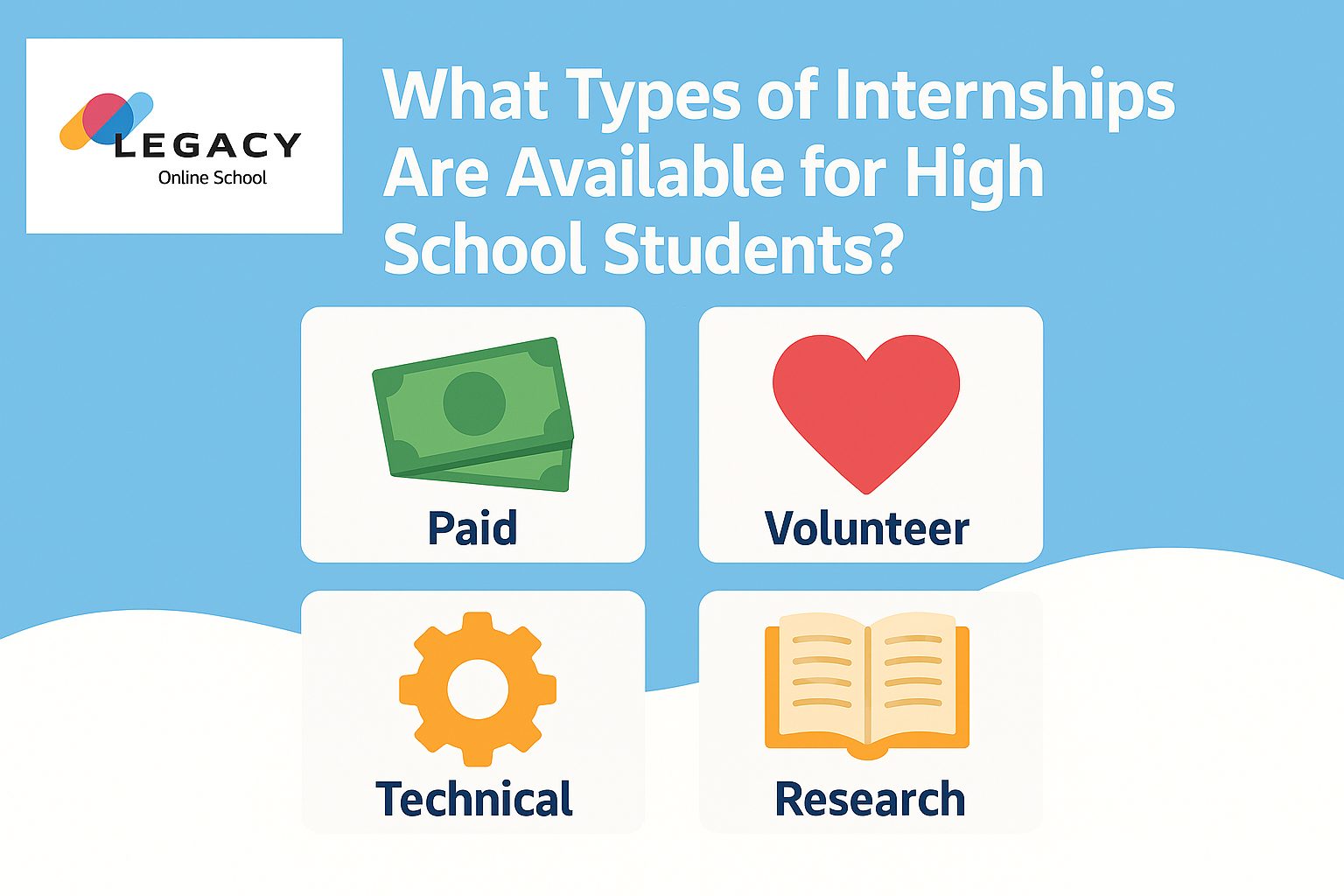
Here’s a quick overview of common categories:
| Internship Type | Example Programs or Paths | Notes |
| STEM Research | NASA Internships, MIT RSI, local university labs | Competitive, often requires recommendations or essays |
| Healthcare / Pre-Med | Stanford Clinical Internship, hospital volunteering | Mostly observational but valuable for future applications |
| Business / Startups | Local business outreach, Junior Achievement, LinkedIn cold emails | Often self-initiated; great for marketing or management |
| Creative / Media | NYC Ladders for Leaders, school newspaper internships | Skills in writing, video editing, or graphic design help |
| Government / Civic | Congressional Page Programs, city offices | Involve policy exposure, public speaking, or admin tasks |
| Tech and Coding | Google Computer Science Summer Institute | Focused on software, Python, web development |
| Environmental / Field | Local nature centers, Sierra Club youth programs | Hands-on, great for students interested in ecology |
Summer Internships
Summer internships are a great way for high school students to get real-world experience. With no school during summer, it’s easier to try out a job, learn new skills, and boost your college application. But because many students apply, it’s important to plan early. Some internships are full-time for six to eight weeks. Others are just a few hours a week. No matter the schedule, what matters most is showing up, being responsible, and trying your best.
Many students join national programs. For example, Bank of America’s Student Leaders program gives paid internships at nonprofits and includes a trip to Washington, D.C. The Smithsonian YES! program lets students work in museums and science labs in D.C.
Universities also offer summer research internships. These are often unpaid but great for students interested in science. For example, the University of Iowa’s SSTP program lets students work on research projects with real professors for five weeks.
Deadlines for summer internships typically fall between December and March, especially for national or university-affiliated roles.
Research Internships in Science and Medicine
“I had a high school student before for an entire semester. In the beginning she would shadow me, label plates and tubes, make media/agar plates and other simple house keeping stuff until she had an idea of what she wanted to work on. I gave her papers to read that were relevant to the work I was doing to get her to read some scientific literature and think critically”
Research internships in science and medicine are some of the best and hardest to get for high school students. They give you real lab experience, a mentor, and can help your college application stand out. But you need more than good grades—you need to show real interest and curiosity.
Most science internships are at universities, hospitals, or government labs. They usually happen in the summer. Students work on a project with a mentor. One of the top programs is the Research Science Institute (RSI) at MIT. It picks about 100 students from around the world. It’s free and includes housing, food, and a small payment.
Medical internships are more about learning and watching, not treating patients. For example, Stanford’s Clinical Summer Internship lets students hear talks from doctors, visit hospital areas, and do medical roleplays. You learn what it’s like to work in medicine without actually caring for patients.
Some hospitals have teen programs where students volunteer or join science camps. One student on Reddit said they joined a hospital program and got to be in labs in the morning and follow nurses in the afternoon. That helped them decide they liked genetics more than working with patients.
Another way to get an internship is to email professors directly. If you’ve taken science classes or done personal projects, you can write to a professor and explain why you’re interested. Some professors might let you help with things like coding or simple lab work.
Remote Internship Programs for High School Students
Here’s a breakdown of reliable remote internship options:
| Program / Platform | Focus Area | Key Details |
| Forage | Business, law, consulting, tech | Free virtual work simulations from top companies (JP Morgan, BCG) |
| Chegg Internships | Marketing, writing, tech | Includes filters for remote and high school–level roles |
| NextGen Bootcamp | Coding, finance | Paid programs with project-based virtual internships |
| Girls Who Code Summer Immersion | Tech / CS for female students | Free, selective; includes mentorship and career development |
| Independent Outreach | Any field | Students cold-email organizations with a specific value offer |
Some remote internships are short-term (1-2 weeks), while others run 6-8 weeks over the summer. A few even stretch into the school year on a part-time basis. That flexibility makes them ideal for students balancing academics, family responsibilities, or other commitments.
Remote internships may not offer the coffee runs or office tours of traditional ones, but they provide real tasks, real mentors, and real growth—and for many high schoolers, that’s more than enough.
|
Top Tips from Our Expert
|

Alyssa Mendoza, AP Coordinator and College Prep Specialist
Sources: USA.gov, Reddit