Key takeaways
Harvard's Computer Science program offers a unique blend of flexibility and rigor, allowing students to tailor their education through various concentrations and joint majors. This article outlines the structure of the CS concentration, core curriculum, and the admissions process, emphasizing the importance of demonstrating genuine interest and interdisciplinary connections in applications.
- Harvard's CS program allows students to choose between an A.B. (Bachelor of Arts) and S.B. (Bachelor of Science) degree, with the latter requiring more STEM courses (Harvard, 2023).
- Students are encouraged to take CS50 as an introductory course, which covers essential programming concepts and prepares them for advanced classes.
- Many students pursue joint concentrations, with popular combinations including CS + Math and CS + Economics, which often lead to high-impact career opportunities (Harvard, 2023).
- Admissions focus on intellectual curiosity and real-world impact, so applicants should highlight unique projects and interdisciplinary interests in their essays.
Contents
Harvard’s Computer Science program isn’t just a badge of prestige—it’s one of the most flexible and intellectually rich CS tracks in the Ivy League. Let’s break down how it works—from required courses to double majors and what you’ll need to get in.
Concentration Requirements for Computer Science
Harvard calls majors “concentrations,” and the CS concentration offers both depth and freedom. Students complete a mix of foundational classes and a capstone experience (like a thesis or advanced project).
Most CS concentrators graduate with either an A.B. (Bachelor of Arts) or S.B. (Bachelor of Science) degree. The S.B. has more required STEM courses, while the A.B. allows more flexibility for students who want to explore the humanities or pursue a second field.
Core Curriculum for Harvard CS
“A friend of mine said you should go through Harvard’s CS50 first then other ‘heavy’ stuff…”
The first step is usually CS50: Introduction to Computer Science, Harvard’s famous entry-level course. It covers programming basics (C, Python, web), algorithms, data structures, and more. It’s designed to challenge both beginners and experienced coders.
After CS50, students typically move into:
- CS51 (Abstraction and Design in Computation)–functional programming and software design principles
- CS61 (Systems Programming and Machine Organization)–low-level architecture, memory, and operating systems
- CS121 (Introduction to Theoretical Computer Science)–proofs, automata, complexity theory
- CS124 (Data Structures and Algorithms)–performance, efficiency, classic algorithms
- CS20 (Discrete Mathematics for CS)–mathematical foundations like logic, set theory, combinatorics
Many students also take math courses like Math 21a/b or AM 21a/b to strengthen their quantitative background. From there, Harvard allows deep exploration.
Double Majoring with Computer Science
The university allows students to pursue a joint concentration or a second stand-alone concentration, but it comes with strict rules and high expectations. Here’s a quick breakdown of how Harvard distinguishes the options:
| Option | What It Means? | Thesis Requirement | Approval Needed |
| Joint Concentration | Integrated study across two departments with one unified thesis | Yes – must satisfy both fields | Both departments + college |
| Double Concentration | Two independent fields with separate course requirements | Optional, but strongly encouraged | Petition + academic advising |
Who Can Pursue a Double Major at Harvard?
To pursue a joint concentration, students need:
- An academic advisor in both fields
- A senior thesis that connects both disciplines
- Approval from both departments
For example, a student combining CS and Philosophy might write a thesis on the ethics of autonomous systems.
Pros and Cons of Adding a Second Concentration
On the plus side, a second concentration can:
- Broaden your expertise across disciplines, which is valuable for careers in research, tech policy, entrepreneurship, or academia
- Help you stand out in competitive job markets by showing depth and versatility
- Let you explore personal interests that don’t directly align with your main field, making your college experience more well-rounded
- Create opportunities for interdisciplinary research or thesis work, especially if the two fields are intellectually linked

But there are also real trade-offs:
- You’ll have to juggle two full sets of requirements on top of Harvard’s general education and distribution courses
- Some double concentrators struggle with scheduling conflicts, especially when both departments offer required courses at the same time
- You might have less room for electives, study abroad, or internships during the school year
- Burnout is a genuine risk. Harvard’s workload is already intense, and taking on two demanding programs can crowd out downtime, creative projects, or social life
Joint Concentration Options in CS
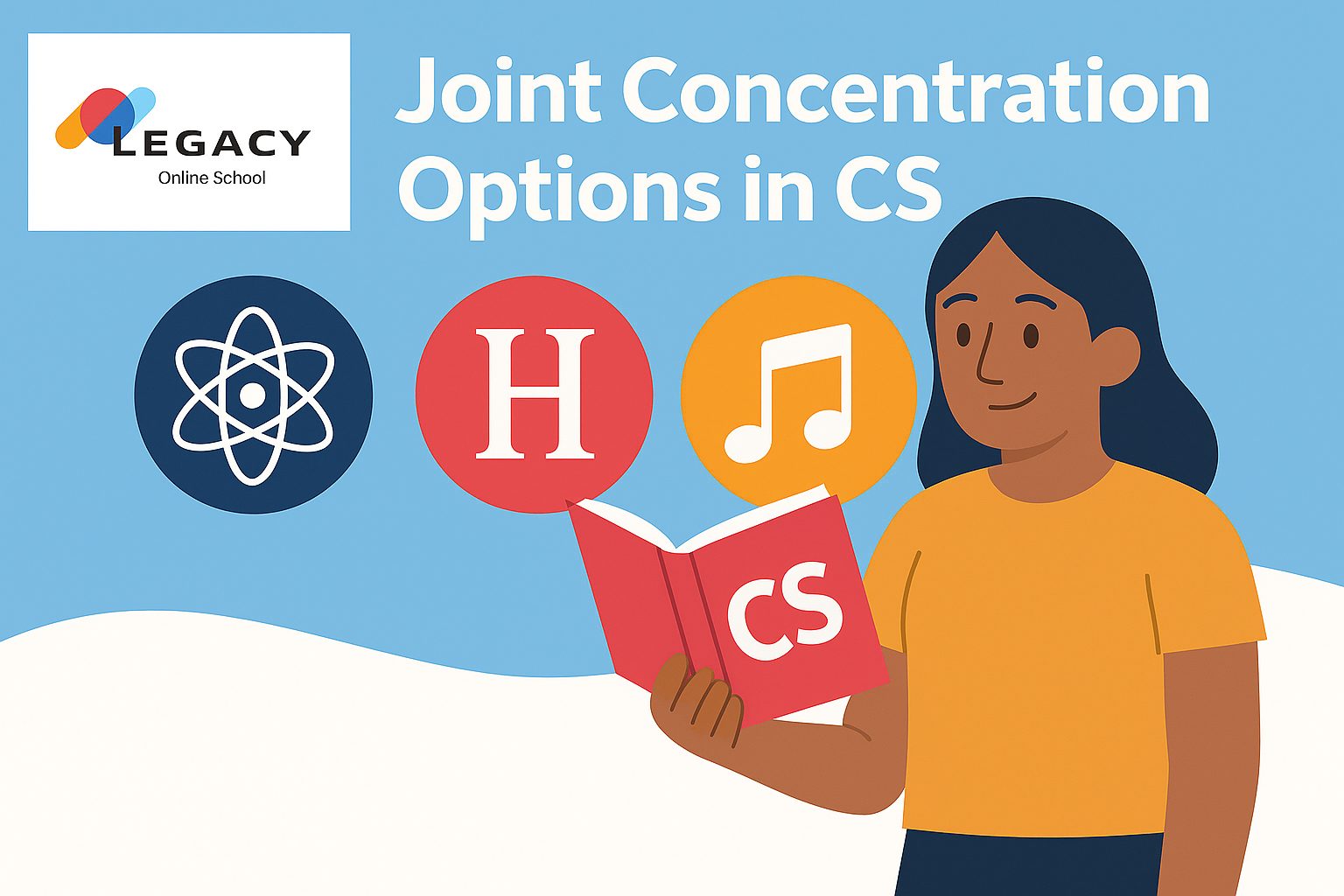
Some joint concentrations with Computer Science are so common at Harvard that they’ve practically become tracks of their own. These pairings aren’t just trendy—they make academic sense and often lead to high-impact research or career opportunities. Here’s a look at the most frequent and meaningful combinations:
- CS + Math: Ideal for students focused on algorithms, cryptography, machine learning theory, or computational complexity. Many students in this combo head toward PhD programs or tech R&D roles.
- CS + Statistics: Perfect for data science and AI. This pairing gives you the analytical rigor of stats with the programming depth of CS, which is highly marketable in industry and research.
- CS + Economics: Popular among students interested in fintech, game theory, or computational economics. This joint path often leads to roles in tech policy, analytics, or venture capital.
- CS + Linguistics: Great for natural language processing and human-computer interaction. Students often collaborate with labs like the Harvard NLP group and go on to work in AI startups or graduate programs.
- CS + Philosophy: A compelling choice for students exploring ethics in tech, logic, or AI decision-making. While it’s less technical, this path supports thoughtful, systems-level thinking—something top tech companies increasingly value.
- CS + Neuroscience: Strong for students interested in brain-computer interfaces, cognitive computing, or computational neuroscience. Many go on to work in neural engineering or neurotechnology labs.
Each of these pairings requires approval and a unified thesis that bridges the two disciplines. That means you need a clear academic narrative—not just “I like both.” Advisors expect students to articulate how the combo fits into their goals and what unique questions or problems they want to explore at the intersection.
How to Declare a Joint Concentration?
“Joint concentrations require you to write a thesis which incorporates both fields. Double concentrations don’t require a thesis (it’s like you’re doing two independent concentrations). Also joint concentrations can double count as many classes towards both concentration reqs, while for double concentration it’s more limited (you can only double count like 3 classes I think)”
Declaring a joint concentration at Harvard means you’re officially combining two fields into one academic plan—with a shared senior thesis. It’s more than just taking courses in both areas. You have to show how the two subjects connect in a deep and meaningful way.
The process usually starts in sophomore year. After trying out both subjects, you meet with advisors from each department to see if the combination works. Not every pair is approved automatically—both departments must agree that your idea makes academic sense and that your future thesis will truly combine both fields.
Once approved, you fill out the Harvard Joint Concentration Declaration Form, list your planned courses, and name your two thesis advisors—one from each department. The thesis must be co-supervised and fully integrated, not just two topics stuck together.
Examples:
- A CS + Neuroscience thesis might study machine learning tools for analyzing brainwave data.
- A CS + Philosophy thesis could explore ethical theories in AI.
Secondary Field Opportunities in CS

At Harvard, a secondary field is essentially a minor—an official way to explore another academic area without committing to a full joint concentration. For students majoring in Computer Science, adding a secondary field can round out your profile, especially if it connects to your career interests or long-term goals.
The CS Department itself doesn’t offer a “secondary in CS” for non-CS majors, but CS concentrators can declare a secondary field in many disciplines, including:
- Economics
- Statistics
- Philosophy
- Neuroscience
- Government
To declare a secondary, you’ll typically need to complete five approved courses in that department and submit a Secondary Field Declaration Form through my.harvard. Each department has its own rules—for example, some require a specific sequence or a minimum grade threshold.
Getting into Harvard’s CS Program
Admissions officers look for more than just strong grades. They want to see intellectual curiosity, problem-solving ability, and creative thinking—especially in STEM. Competitive applicants often show:
- High achievement in math and science courses, including AP or IB when available
- Participation in coding competitions, robotics, or computer science clubs
- Personal projects, apps, or contributions to open-source code
- Research experience or summer programs like MITES, RSI, or Google CSSI
- Strong letters of recommendation from teachers in math or science
A well-written personal essay can also help you stand out. Harvard looks for students who think independently and care about making an impact—your essay is your chance to show that.
Admissions Requirements for Computer Science
According to Harvard’s 2025–2026 admissions page, there are no required courses—but top CS applicants typically have:
- GPA near 4.0 with strong performance in AP Calculus BC, AP CS A, and Physics
- Competitive test scores (SAT/ACT are optional, but many applicants still submit)
- Advanced projects in coding, robotics, or data science
- Participation in summer programs like MITES, RSI, or Google CSSI
Mistakes to Avoid in the Harvard CS Application
“One of the lesser known facts about college admissions is that a few points on your GPA or SAT aren’t really that big of a deal. Colleges will often take an applicant with lower stats because of something else interesting or compelling in their application. Maybe they have a unique and valuable skill. Maybe they just seem like a really incredible person”
One big mistake CS applicants make when applying to Harvard is thinking that top scores and a long list of APs are enough. Harvard doesn’t admit stats—they admit people. Here’s what can hurt your application, even if your numbers are strong:
- No real proof you care about CS
- Essays that sound cliché
- Only showing tech. If your whole application is just CS, it might feel flat
- Weak recommendation letters
- Not showing the right fit. Harvard’s CS program focuses on theory and flexibility. If you only care about coding for a job, they’ll notice the mismatch
- A scattered story. All parts of your application should connect
|
Top Tips from Our Expert
|

Alyssa Mendoza, AP Coordinator and College Prep Specialist
Sources: Harvard, Reddit