Key takeaways
Understanding your GRE scores is crucial for graduate school applications, as they can significantly influence your chances of admission. This article breaks down what constitutes a "good" GRE score, how to interpret your score report, and offers strategies for improvement.
- Top STEM programs typically expect a Quantitative score of 165 or higher, while humanities programs may prioritize Verbal scores (source: Reddit).
- A combined Verbal + Quant score above 320 is often sought by elite schools, but requirements can vary widely by program.
- A score of 160 in Quantitative places you in the 70th percentile, indicating average performance for math-heavy programs.
- Use the ScoreSelect option to send only your best scores to schools, allowing you to highlight your strongest performance.
Contents
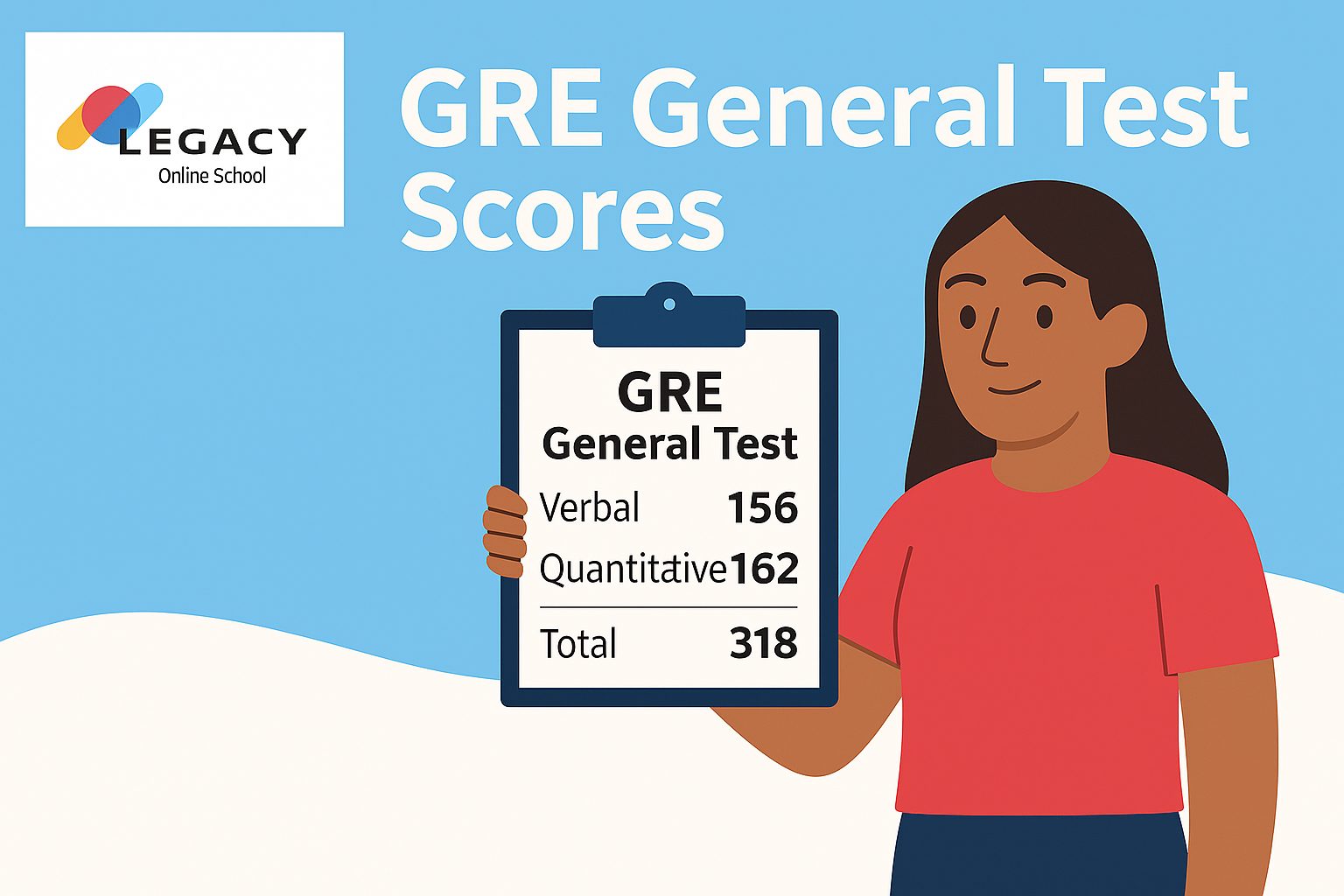
If you’re applying to graduate school, your GRE scores might be one of the most important numbers in your application. But what exactly makes a GRE score “good”? And how should you read your score report to know where you stand? Let’s find out answers to these questions.
What Is a Good GRE Score for Graduate School?
“Grad programs in STEM do not care about ur verbal score (as long as it is not catastrophic). They care about the quant score so it must be 165+. Also note that a GRE score won’t get u in—they just filter people out with low scores. Usually i believe the lower bound is between 163 to 165 for most top programs and when u score 165+ they look further into ur application”
A “good” GRE score depends on the program and field you’re targeting. Top STEM programs often expect higher Quantitative scores, while humanities and social science programs may weigh Verbal more heavily.
As a general rule:
- Verbal Reasoning: 155-165 is competitive
- Quantitative Reasoning: 160-170 is strong for STEM
- Analytical Writing: 4.5+ is above average
Elite schools often look for a combined Verbal + Quant score above 320, but this varies widely.
What Percentile Represents a Good GRE Score?
Your raw score (130-170 per section) translates to a percentile—this shows how you performed relative to other test takers. Here’s a quick breakdown:
| Score | Verbal Percentile | Quant Percentile |
| 170 | 99% | 97% |
| 165 | 96% | 86% |
| 160 | 85% | 70% |
| 155 | 69% | 54% |
| 150 | 48% | 35% |
So a 160Q might feel strong, but if you’re applying to math-heavy programs, it could be just average.
How Are GRE Test Scores Calculated?
GRE scores are calculated based on a mix of raw points and scaled scoring, and each section follows its own process. The GRE General Test includes three sections: Verbal Reasoning, Quantitative Reasoning, and Analytical Writing. Only the Verbal and Quantitative sections are scored on the same numerical scale—130 to 170—while Analytical Writing uses a separate 0 to 6 scale.
For Verbal and Quantitative, here’s how it works:
- Raw score is the number of questions you answer correctly. There’s no penalty for wrong answers, so it’s always worth guessing if you’re unsure.
- Your raw score is converted to a scaled score between 130 and 170. This conversion accounts for slight differences in difficulty between different test versions. For example, if you take a slightly harder version of the test than another student, the scale adjusts so you’re not penalized.
- The GRE uses a multi-stage adaptive design. This means your performance on the first set of questions determines the difficulty of your second set. Doing well early unlocks a tougher second section—which also gives you the chance to score higher overall.
The Analytical Writing section is graded a bit differently:
- Each essay is scored from 0 to 6 by a human rater and an AI system.
- If the two scores are close, they are averaged.
- If the scores are very different, a second human rater is brought in to review.
- Your final writing score is the average of the two essay scores, rounded to the nearest half-point.
What Are the Score Reports for the GRE General Test?
“The Test Taker Score Report includes identifying information such as your contact info, birth date, gender, and intended graduate major. It shows your test score history for the past five years”
GRE General Test score reports include detailed information about your performance, and understanding how to read them can help you present your scores effectively to graduate programs. Every test-taker receives two types of score reports: the Test Taker Score Report and the Institution Score Report.

The Test Taker Score Report is what you see when you log into your ETS account. It includes:
- Your name, address, birthdate, and gender
- The test date and test center
- Scores for:
- Verbal Reasoning (130-170)
- Quantitative Reasoning (130-170)
- Analytical Writing (0-6)
- The percentile ranks for each score (showing how you compare to other test-takers)
- Your cumulative score history for the past five years, including all valid GRE General and Subject Test scores
The Institution Score Report is what schools receive. It includes:
- Your contact and identifying information
- Test date
- Section scores and percentiles
- Intended graduate major
- No information about other score recipients, meaning each institution sees only its own copy
One key detail: you can choose to send only certain test dates through ScoreSelect, a feature ETS offers. So if you’ve taken the test multiple times, you control which scores go to which schools.
For example, if you scored higher on Quantitative in a later test but had a stronger Verbal performance on an earlier one, you can choose the report that shows your best combined performance.
What Information Is Included in the Score Report?
Whether you’re reviewing your own results or sending them to a school, here’s what shows up in a standard GRE General Test score report::
- Personal Information:
- Full name (must match your ID exactly)
- Date of birth
- Gender
- Address (at the time of testing)
- Test Information:
- Date of the GRE test
- Type of test (GRE General or Subject)
- Test center or at-home option
- Section Scores:
- Verbal Reasoning
- Quantitative Reasoning
- Analytical Writing
- Each score includes a percentile rank, showing how your performance compares to other test takers. For instance, a 165 in Verbal may place you in the 96th percentile.
- Score History:
- All valid GRE scores from the past five years
- Dates for each test session
- This section includes both General and Subject test scores unless canceled
- Intended Graduate Major:
- The field of study you selected when registering
- Schools may use this to match your scores to specific departments
- Security and Authenticity Details:
- Report issue date
- ETS ID
- Official formatting that confirms the document was issued by ETS
Graduate schools do not see where else you sent your scores. If you’re using ScoreSelect, each program only sees the test dates you choose to share.
How to Interpret Your GRE Score Report?
Interpreting your GRE score report means looking beyond the numbers and understanding what they tell admissions committees about your readiness for grad school. Whether you’re applying to a competitive STEM program or a writing-intensive social science degree, each section of the report offers specific insights.
Start with your Verbal and Quantitative Reasoning scores. These are scored on a scale from 130 to 170. A score of 150 is roughly average, while a 160+ usually indicates strong performance. But context matters. For example, a 165 in Quantitative might be necessary for engineering or finance, while a 158 in Verbal could be highly competitive for a top humanities program.
Next, look at your percentile ranks, which show how your scores compare to other test-takers. A percentile of 90 means you scored better than 90% of people who took the test. Percentiles help schools understand your performance relative to the broader applicant pool, especially since scaled scores don’t fluctuate much year to year.
The Analytical Writing section is scored from 0 to 6 in half-point increments. While a 4.0 is considered average, top schools often expect at least a 4.5 or 5.0—particularly in programs that require strong written communication skills.
Your report also includes a score history, showing all valid GRE scores from the past five years unless you’ve canceled a test. This section is useful for tracking progress or highlighting consistent strengths across multiple attempts.
Legacy Online School helps students interpret these numbers based on their target programs. We encourage applicants to compare their scores to averages listed on grad program websites—many of which publish median GRE scores for admitted students.
How Can You Improve Your GRE Score?

Improvement comes down to targeted, time-efficient prep.
- Take a diagnostic test to identify weak areas
- Focus your study plan on the lowest-performing section
- Use official ETS practice tests to simulate real conditions
- Drill vocabulary (for Verbal) or formulas (for Quant) daily
- Practice timed essays and get feedback if possible
What to Do if Your GRE Score is Low?
Start by checking the score ranges for admitted students at your target schools. Many programs publish this information on their admissions pages. For example, UCLA’s Department of Psychology reports average GRE Quantitative scores around 160, but the AWA section is often less emphasized unless you’re applying to writing-heavy programs.
If you’re significantly below those averages, consider retaking the GRE. You can take the test once every 21 days, up to five times within a year. ETS even lets you choose which scores to send using the ScoreSelect option—so schools never need to see the lower one. According to ETS, about 25% of test takers improve their scores the second time.
That said, retaking isn’t always necessary. Grad programs consider the full application:
- GPA and transcript strength
- Letters of recommendation
- Personal statement and research experience
- Fit with faculty and the program’s focus
If you scored lower than you hoped, use your personal statement to highlight your strengths and context. For example, if English is your second language and you scored lower on Verbal, explain how your academic success still shows strong analytical skills.
You can also apply test-optional if your programs allow it. Many U.S. graduate schools are de-emphasizing GRE scores, especially in the social sciences and humanities.
|
Top Tips from Our Expert
|

Alyssa Mendoza, AP Coordinator and College Prep Specialist
Sources: ETS, Reddit