Key takeaways
Mastering the foundational concepts of biochemistry is crucial for success in the AP Biology Unit 1 exam. This article highlights the importance of understanding organic molecules, macromolecules, and the role of chemical bonds in biological processes. By utilizing effective study techniques and resources, students can enhance their preparation and confidence for the exam.
- Organic molecules, consisting of carbon, hydrogen, oxygen, and nitrogen, are essential for cellular functions and are frequently tested in the AP Biology exam.
- Students should focus on the structure and function of macromolecules, such as proteins and nucleic acids, as they play critical roles in biological reactions.
- Enzymes significantly lower activation energy in biochemical reactions, making their understanding vital for exam success.
- Utilizing study techniques like flashcards and practice questions can improve retention of key terms and concepts, leading to better performance on the exam.
Contents
- 1 What Are the Key Concepts in AP Biology Unit 1 Chemistry of Life?
- 2 How Do Organic Molecules Influence Biological Reactions?
- 3 What Study Guides Are Available for AP Biology Unit 1?
- 4 How Can I Prepare for the AP Biology Exam on Chemistry of Life?
- 5 What Common Mistakes Should I Avoid in AP Biology Unit 1?
The AP Biology exam is filled with complex concepts, especially found in Unit 1: The Chemistry of Life. Preparation for this exam can be difficult and tough as it tests the foundational knowledge of biological processes that govern living organisms.
This article will discuss key concepts, explore organic molecules and their influence on biological reactions, offer study guides and tips to help students prepare for their AP Biology Exam.
What Are the Key Concepts in AP Biology Unit 1 Chemistry of Life?
Understanding Organic Molecules
What are organic molecules? They are the backbone of life that consist of carbon atoms bonded to elements like hydrogen, oxygen, and nitrogen. The unique properties allow organic molecules to form different structures like chains and rings that appear to create complex cellular compounds like proteins, nucleic acids, and lipids. These molecules are crucial for cells to function and appear in various biological reactions.
Students must understand that it is vital to understand the structure and function of these molecules to successfully prepare for the AP Biology exam since many questions include these molecules.
The Role of Macromolecules in Biology
Macromolecules include the following listed below:
| Name | Where do they appear? | What do they do? |
| Proteins | Amino acids | Serve as enzymes, structure components, and signaling molecules. |
| Nucleic acids | DNA and RNA | Hold the genetic information necessary for the growth and reproduction of organisms |
| Carbohydrates | Glucose, starch | Act as vital energy resources. |
| Lipids | Steroids, phospholipids | Provide structural support and energy reserves. |
Importance of Chemical Bonds and Reactions
Chemical bonds are essential to keep the structure and function of organic molecules acting. The bonds include covalent and hydrogen bonds. Formation and breaking of these bonds drive chemical reactions.
A good example to show a chemical reaction is how enzymatic reactions involve the formation of temporary bounds between enzymes and substrates. These bonds and their impact on molecular stability alongside reactivity is critical if students want to master Unit 1 of AP Biology.
How Do Organic Molecules Influence Biological Reactions?
The Function of Enzymes in Chemical Reactions
AP Biology emphasizes the importance of enzymes in catalyzing biochemical reactions, reducing activation energy and facilitating efficient metabolic processes. Understanding the mechanism of enzyme action, including factors like pH, temperature, and substrate concentration, is crucial for AP Biology exam questions. This knowledge is indispensable for understanding enzyme functions and their implications in biological reactions.
Types of Organic Molecules: Proteins, Lipids, Nucleic Acids
AP Biology Unit 1 includes discussion of how living organisms rely on various organic molecules for various functions. The functions include proteins providing structural support, lipids storing energy, and nucleic acids storing and transmitting genetic information, all of which are crucial in the formation of cell membranes and cell structures.
Understanding the structural characteristics of these molecules, like the nucleotide structure of DNA and RNA, and how they contribute to biological functions is key to passing the AP Bio exam.
How Carbon’s Structure Affects Biological Functions
Carbon bonds covalently with four atoms can produce numerous essential life-related molecular formations. The flexibility of carbon creates numerous possible arrangements of complex organic molecules which fulfill various vital roles inside living things. The long carbon atom chains possess different structural arrangements that influence the molecular interaction behavior between them. Knowledge about carbon molecular structure along with its biological implications will support your exam performance by enabling better understanding of molecular interactions and biological functions during the AP Biology exam.
What Study Guides Are Available for AP Biology Unit 1?
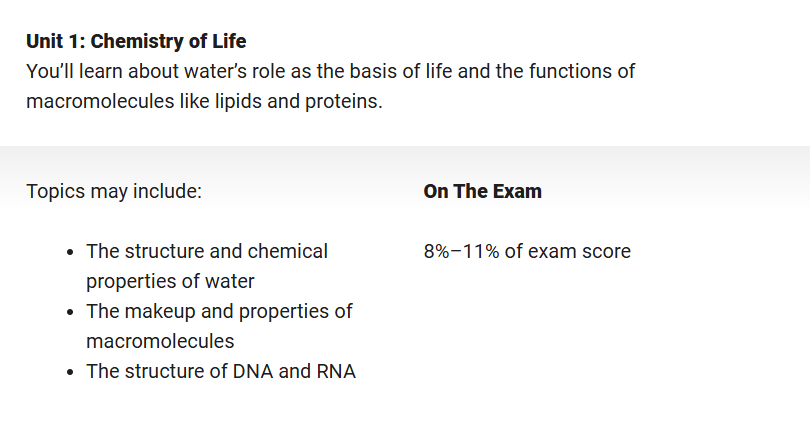
AP Central makes sure students are aware of what they will encounter during the exam preparation.
Recommended Videos for Understanding Unit 1
Here are several examples of what video resources students can use to prepare for AP Biology Unit 1 listed below:
Students should check out videos like these to help get clear explanations and visual aids that can enhance their understanding of complex topics. Using these videos as supplementary resources alongside their textbooks would help high schoolers grasp complicated biological terminology with more ease.
Key Terms and Definitions to Know
Students need to know definitions to terminologies like organic molecules, macromolecules, and various types of chemical bonds. Terms like enzyme, substrate, covalent bond, nucleotide structure, and hydrogen bond must remain at the front of a student’s study efforts.
How can students master all these complicated terminologies and definitions? Flashcards is one of the best study techniques for memorization that will assist students in recalling definitions and implications in biological contexts. Students should build up their vocabulary to tackle both multiple choice and free response questions on the AP Biology exam.
Practice Questions for Better Preparation
Students must utilize online resources, study guides, and review books that include practice questions. Practicing helps students understand the format of the AP Biology exam and will help alleviate stress connected to taking an exam since the students will be more aware of how the exam works.
Students should utilize online resources, such as Legacy Online School’s comprehensive AP Biology study guides, along with other study guides and review books that include practice questions.

How Can I Prepare for the AP Biology Exam on Chemistry of Life?
“I’ve been using online resources like Learn-Biology.com and Khan Academy to supplement my studying. The practice questions and video lessons have really helped reinforce the material.”
Effective Study Techniques for Unit 1
Here are several study techniques students can utilize while preparing for AP Biology Unit 1 listed below:
- Summarize each chapter in their own words.
- Create concept maps to visualize relationships between different organic molecules.
- Engage in group study sessions to talk about key concepts.
Here are several active learning techniques that students can use additionally listed below:
- Teach the material to someone else.
- Apply concepts to real-life scenarios.
- Make use of resources like textbooks, online platforms, and videos.
Creating a Study Schedule for AP Biology
Here are several steps students can take when creating a study schedule for AP Biology:
- Break down content into manageable sections.
- Assign specific study times for each topic.
- Incorporate periodic reviews for reinforcement.
- Allocate time for practice questions.
- Maintain an organized schedule to reduce exam stress.
- Include breaks and rewards for goal achievement.
Legacy Online School offers tailored AP Biology study plans that incorporate these strategies, ensuring a comprehensive and organized approach to exam preparation.

Utilizing Past Exam Questions as Study Material
Students should use the past exam questions as study material. They can find more about the previous questions on the AP Central, an online platform hosted by College Board. The College Board is responsible for all AP exams in the United States.
Here are several practices that students can use when studying past exam questions listed below:
- Utilize past exam questions for practice.
- Familiarize oneself with the exam format: multiple choice, free-response.
- Develop effective test-taking strategies.
- Analyze Unit 1 questions.
- Identify test pattern patterns.
What Common Mistakes Should I Avoid in AP Biology Unit 1?
Misunderstanding the Structure of Molecules
Here are some common mistakes students make when studying the structure of molecules:
- Overlooking the structure of organic molecules and their function.
- Misunderstanding of protein atom arrangement can lead to misunderstandings.
Students can avoid these mistakes by studying structural characteristics of organic molecules and functional group properties.
Overlooking Key Concepts in Enzyme Function
Another frequent error is neglecting the importance of enzyme function and the factors that influence it. Students often run into misconceptions about metabolic processes due to lack of understanding of temperature and pH changes.
Another part of the problem is how high schools may not understand the importance of understanding enzyme action mechanisms, active site concept, and inhibitors’ impact on enzyme functionality.
Neglecting the Importance of Chemical Bonds
Students often underestimate the significance of chemical bonds in determining molecular interactions and biological reactions. Misunderstanding how covalent and hydrogen bonds influence the behavior of organic molecules is one of the biggest issues students bump into when studying for the AP Biology Unit 1 exam. Students who prioritize thoroughly understanding these concepts are better prepared for the AP Biology Unit 1 Exam.

FAQ
Q: What is covered in AP Biology Unit 1 regarding the chemistry of life?
A: AP Biology Unit 1 focuses on the foundational concepts of biochemistry, including the structure and function of biomolecules such as carbohydrates, proteins, lipids, and nucleic acids. It emphasizes understanding the properties of carbon and how it forms the backbone of biological molecules.
Q: How can I prepare for the AP Biology Unit 1 test?
A: To prepare for the AP Biology Unit 1 test, review the chapter summaries, take practice quizzes, and familiarize yourself with the molecular formulas of key substances. Utilize resources like the learn-biology.com website, which provides everything you need to know about AP Biology.
Q: Where can I find a transcript of AP Biology Unit 1 material?
A: You can find a transcript of AP Biology Unit 1 material on educational websites like learn-biology.com. These transcripts offer detailed descriptions and key concepts that are essential for understanding the chemistry of life.
Q: What is the importance of carbon in biological molecules?
A: Carbon is crucial in biological molecules because it can form four covalent bonds, allowing for complex structures and a variety of functional groups. This versatility makes carbon the primary element in biomolecules such as proteins, lipids, and nucleic acids.
Q: How do monomers relate to the synthesis of macromolecules?
A: Monomers are the smallest units that can join together through covalent bonds to form larger macromolecules. In AP Biology Unit 1, understanding how monomers like amino acids and nucleotides compose proteins and nucleic acids is essential for grasping biochemical synthesis processes.
Q: What type of questions can I expect on the AP Biology Unit 1 quiz?
A: The AP Biology Unit 1 quiz will likely include multiple-choice questions (MCQ) that assess your knowledge of the key concepts, including the properties of water, the structure of cellular macromolecules, and the importance of buffers in biological systems.
Q: Can you explain the concept of directionality in biomolecules?
A: Directionality refers to the orientation of macromolecules, such as DNA and proteins, which is important for their function. For instance, DNA sequences are read in a specific direction, which is fundamental for processes like replication and transcription.
Q: How can I give credit when using resources for AP Biology Unit 1 study?
A: When using resources, it’s important to give credit to the original creators. If you use materials from websites like learn-biology.com or any other educational content, make sure to reference them properly in your study notes and discussions.
Q: What should high school students know about AP Biology Unit 1 before the semester finals?
A: High school students should focus on understanding the fundamental concepts of biochemistry, including the structure and function of various biomolecules, the role of carbon, and the process of synthesis. Mastering these topics will help students excel in their semester finals.