Key takeaways
Understanding gene expression and regulation is essential for mastering AP Biology Unit 6, as these concepts illuminate the molecular mechanisms that govern biological processes. This knowledge not only prepares students for exams but also enhances their comprehension of how genes function and interact within living organisms.
- Transcription and translation are universal processes in all living organisms, emphasizing the unity of life (source: Gabe Poser).
- RNA polymerase and promoter sequences play a crucial role in regulating gene expression by determining when and which genes are transcribed.
- Mutations can significantly alter gene expression, with point mutations potentially changing protein functions and leading to severe phenotypic effects.
- Proper mRNA processing, including splicing and the addition of a 5' cap and poly-A tail, is vital for producing functional proteins and ensuring efficient translation.
Contents
AP Biology’s Unit 6 requires students to understand both gene expression and regulation because these concepts reveal how biological processes function at a molecular level. The article examines the intricate aspects of AP Biology Unit 6 by studying the mechanisms which control gene expression.
Students who examine these concepts will become more prepared for AP Biology tests and quizzes leading to success in their AP Biology examinations.
What is Gene Expression and How is it Regulated in AP Biology Unit 6?
“Teachers often emphasize that transcription and translation are universal processes occurring in all living organisms, highlighting the unity of life.”
Understanding Transcription and Translation
Transcription is a process where the genetic information encoded in a DNA molecule is transcribed into RNA. This RNA (in this case mRNA) serves as a template for translation. The next phase includes amino acids that are assembled into proteins.
The transcription process goes as listed below:
- RNA polymerase binds to a promoter region on the DNA strand
- The enzyme moves along the DNA by unwinding it
- Unwinded DNA synthesizes an mRNA molecule that complements the DNA’s template strand
- mRNA travels to the ribosome
- mRNA guides the synthesis of proteins where each is defined by a specific sequence of amino acids.
Role of RNA Polymerase and Promoters
RNA polymerase is a critical enzyme in the transcription process that is responsible for catalyzing the synthesis of RNA from a DNA template.
The promoter is a sequence of DNA that signals the RNA polymerase to bind and initiate transcription. These promoters regulate gene expression and determine which genes are transcribed and when.
The binding site of RNA polymerase on the promoter is affected by transcription factors, which enhances or inhibits the enzyme’s activity. This binding then controls the pace of gene expression.
How Do Organisms Control Gene Expression?
The regulatory system guarantees proper gene expression occurs at designated times within specific cells at appropriate levels. The cellular factors consisting of transcription factors together with enhancers serve to precisely regulate gene expression. DNA accessibility for RNA polymerase is controlled by regulatory proteins which affect transcription rate. The control of gene expression after transcription occurs through modifications made to mRNA including splicing and 5′ cap and poly-A tail attachment.
How Does DNA Replication Influence Gene Expression?
Exploring the DNA Molecule and Template Strand
DNA replication serves as a basic cellular process before cell division to guarantee both daughter cells obtain exact genetic material duplicates. The unwinding of the DNA molecule during replication leads to the formation of a replication fork while DNA synthesis creates two equivalent DNA strands.
The template strand directs the synthesis of a new complementary strand by base pairing that ensures the process remains accurate. Genetic information survives from one generation to the next through replication because new templates for transcription are generated by this process.

What is the Role of Base Pairing in Replication?
The double helical structure of DNA emerges through the base pairing process that arranges nucleotides correctly. DNA polymerase executes replication by decoding template strands while it adds matching nucleotides following the base pairing principles between adenine and thymine and cytosine and guanine. DNA replication depends on this specific matching system to achieve precision because it determines the accuracy of DNA replication and subsequent gene expression. Mutations develop when base pairing mistakes occur which might change gene performance patterns and functional characteristics.
How Mutations Affect Gene Expression
The DNA sequence undergoes alterations known as mutations which modify how genes express themselves. Different types of mutations exist that either alter genes without consequence or modify protein functions or modify regulatory sequences to produce abnormal gene expression patterns. A point mutation modifies a single nucleotide found in DNA which could transform protein amino acid sequences and their operational characteristics. When mutations affect promoter areas it disrupts the ability of RNA polymerase and transcription factors to bind resulting in transcription initiation problems.
What Are the Different Types of Mutations Affecting Genes?
Point Mutations and Their Impact
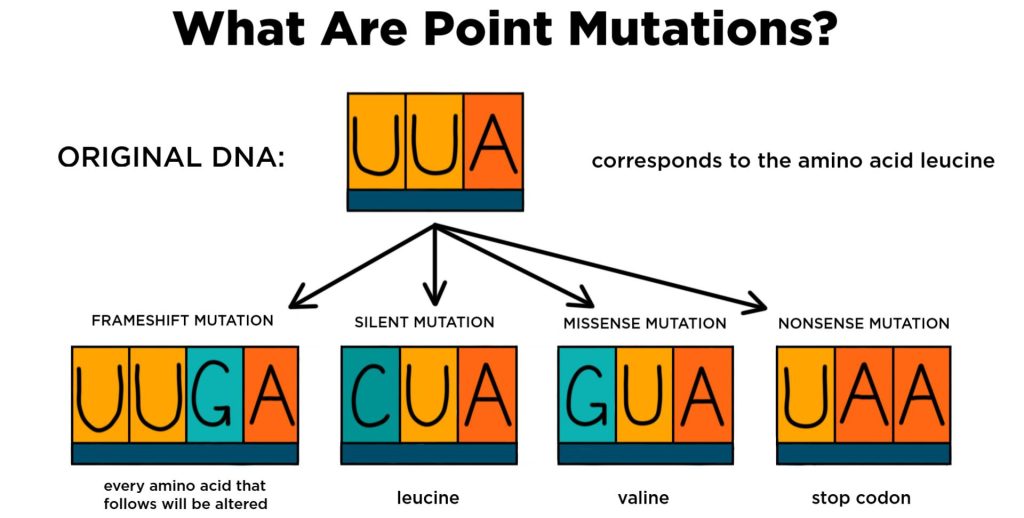
DNA point mutations consist of alterations that modify single nucleotide bases in the sequence. The place where mutations occur alongside the specific nucleotide replacement determines their effects on how genes express themselves.
A synonymous mutation usually produces no changes to amino acid sequence but missense mutations can modify one amino acid leading to possible protein functional alterations. As nonsense mutations occur they create an early stop codon which cuts the protein short and mostly leads to functional protein loss.
Understanding Deletions and Their Consequences
A DNA sequence deletion which removes one or multiple nucleotides creates substantial impacts on how genes express themselves. As a deletion occurs inside a coding sequence it produces a frameshift mutation which modifies the gene reading frame thus changing all amino acids found downstream. Mutations that produce nonfunctional proteins through such DNA deletions lead to severe phenotypic effects which cause developmental anomalies in mutant mice ears.
How Do Mutations Affect Amino Acid Sequences?
Proteins undergo sequence changes because of mutations which might modify their structural configuration along with their functional capabilities. Each unit of three nucleotides called a codon directs the sequence of different amino acids in protein formation. Protein folding and interaction can be affected when a mutation changes a codon since it leads to the substitution of one amino acid with another. Frameshift mutations which occur because of insertions or deletions shift protein reading frames to produce complete sequence changes that result in nonfunctional proteins.
How is mRNA Processed Before Translation?
Role of Splicing in mRNA Maturation
“Students often summarize splicing as a “quality control checkpoint” ensuring mRNA integrity before nuclear export.”
The modification process for mRNA requires splicing along with other changes before protein translation occurs. Splicing services eliminate introns which are non-coding sequences from pre-mRNA while it combines the coding sequences known as exons. The maturation of mRNA requires this process to produce different protein variants from one gene through alternative splicing. A precise intron removal process with correct exon fusion enables the generation of functional mRNA molecules suitable for ribosome translation.
Understanding Introns and Exons
Eukaryotic gene structure incorporates two essential elements which are introns alongside exons. The pre-mRNA contains introns which represent non-coding sequences but these sequences get spliced out before moving on to the translation step. The coding sequences known as exons stay in mature mRNA to specify protein amino acid order. Precise protein diversity from a single gene results from introns and exons splicing through the action of specific splicing factors which monitor accurate exon–intron junctions.
The Importance of the 5′ Cap and Poly-A Tail
The 5′ cap and poly-A tail are critical modifications added to mRNA after transcription. The 5′ cap is a modified guanine nucleotide that protects the mRNA from degradation and assists in ribosome binding during translation.
The poly-A tail is a string of adenine nucleotides added to the 3′ end. It also enhances mRNA stability and facilitates its export from the nucleus. These modifications are vital for ensuring that mRNA is efficiently translated into proteins as they influence the overall gene expression.
How Do Enzymes and Proteins Facilitate Gene Regulation?
Function of Topoisomerase in DNA Replication
Topoisomerase functions as an enzyme which performs critical DNA replication work by reducing the twisting strain that occurs during DNA double helix unwinding. The overwinding of DNA in front of the replication fork poses an obstacle for DNA polymerase movement during replication. Through its enzymatic activity Topoisomerase makes DNA cuts which enable the DNA to unwind and eliminate tension before rejoining the broken ends. Smooth replication depends on this process which indirectly affects gene expression by maintaining the fidelity of the DNA template.
Binding Sites and Their Role in Gene Expression
The attachment of regulatory proteins including transcription factors and RNA polymerase occurs specifically at binding sites which represent particular DNA sequences. The attachment sites exist in promoter regions together with enhancers and silencers to control gene transcriptional activities.
The protein-binding site interaction leads to either an activation or inhibition of transcriptional processes which enables cells to respond effectively to internal and external signals. Cellular homeostasis together with environmental response depends on the accurate regulation of binding site functions.
How Do Enzymes Influence Transcription and Translation?
Genetic information requires enzymes to drive synthesis and regulation operations in transcription and translation processes. RNA polymerase enzymes carry out DNA to mRNA transcription through the transcription process. During translation ribosomal enzymes facilitate peptide bond synthesis between amino acids to build proteins based on the instructions provided by mRNA.
The genetic material integration of retroviruses in host genomes depends on enzymes including reverse transcriptase which transforms RNA into DNA. Enzymatic activities act as essential components which allow gene expression regulation between DNA and protein generation as part of complex molecular processes.

FAQ
Q: What is the focus of the AP Biology Unit 6 MCQ Practice Test?
A: The focus of the AP Biology Unit 6 MCQ Practice Test is Gene Expression & Regulation, which includes topics such as chromosome structure, dna replication process, and the roles of various genes like trp1 mammalian genes and trp2.
Q: How does a mutation affect gene expression?
A: A mutation can change all subsequent amino acids in a protein sequence, potentially altering its function, which may lead to a vital cellular function being compromised. In severe cases, the cell will die because it is unable to perform its essential tasks.
Q: What resources are recommended for AP Biology practice?
A: Recommended resources for AP Biology practice include ap classroom, quizlet for flashcards, quizizz for free interactive quizzes, and other tools that provide verified content to help students learn with flashcards and pace with bite-sized modules.
Q: How is DNA replication related to genetic regulation?
A: During the dna replication process, the original dna molecule is replicated into newly synthesized strands. Any errors in this process can lead to mutations that affect gene expression and regulation in prokaryotic and eukaryotic cells.
Q: In what direction is DNA synthesized?
A: DNA is synthesized in the 5′ to 3′ direction. This directionality is crucial for the replication and synthesis of new DNA strands from the original dna molecule.
Q: How does UV radiation affect genes?
A: UV radiation can cause mutations in DNA, which may lead to effects such as changes in gene expression. For instance, some individuals may have mutations that cause their eyes and skin to react differently to UV exposure, such as failing to tan in response to UV radiation.
Q: What is the role of the trp1 and trp2 genes in gene regulation?
A: The trp1 mammalian genes and trp2 are involved in regulating vital cellular functions. They are transcribed and translated into proteins that help maintain cellular processes and responses to environmental changes.
Q: Why is gene regulation important for cellular function?
A: Gene regulation is crucial for ensuring that genes are expressed at the right time, place, and amount. This regulation maintains vital cellular functions, allowing cells to respond to changes from cells to ecosystems effectively.
Q: How can studying gene expression help in understanding diseases?
A: Studying gene expression helps in understanding how mutations can lead to diseases by altering the normal function of genes. By analyzing these changes, researchers can develop therapies to correct or compensate for these genetic issues.
Q: What are some effective study strategies for mastering AP Biology topics?
A: Effective study strategies include using verified content from resources like ap bio textbooks, online platforms such as quizlet, and interactive tools that allow for pacing with bite-sized learning modules to reinforce understanding of complex topics.