Leave your contact details and Get 3 Live Classes for Free
Thank you! Your submission has been received!
Oops! Something went wrong while submitting the form.
Summer School Enrollment Is Now Open
Leave your contact details and Get 3 Live Classes for Free
Thank you! Your submission has been received!
Oops! Something went wrong while submitting the form.
ACT vs SAT
ACT vs SAT
Thank you! Your submission has been received!
Oops! Something went wrong while submitting the form.

ACT vs SAT

Key takeaways

Choosing between the SAT and ACT involves understanding your strengths and the specific content of each test. Both exams are widely accepted by universities, but they differ significantly in structure and focus. Knowing these differences can help you select the test that aligns best with your skills and preparation strategy.

Key points:
  • The SAT score range is 400-1600, while the ACT ranges from 1-36 (College Board, ACT).
  • The SAT emphasizes algebra and evidence-based reading, whereas the ACT includes a dedicated science section and covers a broader range of math topics.
  • The ACT is increasingly accepting superscores, with more schools adopting this policy (2025).
  • To prepare effectively, take practice tests for both exams to identify which format suits you better and focus on your weakest areas first.

ACT vs SAT

Choosing between the SAT and ACT can feel like picking between Coke and Pepsi—but the differences are more than just branding. Here’s how to figure out which test fits your strengths and goals in 2025.

What’s the Real Difference Between ACT and SAT?

Here’s a side-by-side comparison to start:

Feature SAT ACT
Total Score Range 400-1600 1-36
Parts of the Test 2 sections (Reading & Writing, Math), 800 points each 4 sections (English, Math, Reading, Science), each scored 1-36
Essay Discontinued Discontinued (was optional)
Guessing Penalty No penalty No penalty
Score Averaging Section scores added for total Section scores averaged for composite

Which Test Is Better for You: ACT or SAT?

Both tests are accepted equally by most universities, but they’re not the same. The key isn’t choosing the “easier” test—it’s choosing the one that plays to your strengths.

The SAT rewards strong algebra skills and evidence-based reading. The ACT covers more ground in math and includes a full science section. Some students perform better when they can take their time and dig deep. Others do best when they can move quickly and rely on instinct.

How the Test Content Compares?

Here’s a side-by-side snapshot of how the two tests compare:

Section SAT ACT
Reading Fewer questions, longer passages Shorter passages, more direct questions
Writing/English Pay attention to grammar and how ideas are organized The content is similar, but there’s a bit more focus on grammar rules
Math Divided into two modules (calculator and no calculator), fewer word problems The math is simpler but covers more topics, like matrices
Science No dedicated section—science reasoning is embedded in reading and data questions The science part checks how you understand data and experiments
Essay Removed in 2021

What the ACT Science Section Is About?

The content covers biology, chemistry, physics, and Earth/space sciences, but the real skill it tests is scientific reasoning. Here’s a breakdown of the types of passages you’ll see:

Group What It Tests? What It Looks Like?
Data Representation Graph reading, pattern recognition Charts, tables, graphs with trends
Research Summaries Understanding experimental design Two or more experiments with methods/results
Conflicting Viewpoints Analyzing theories and disagreements Two or more scientists or students with opposing explanations

Most questions don’t require outside knowledge—but having basic familiarity with things like pH, gravity, or DNA helps you feel more confident. What matters most is your ability to process complex visuals quickly and make smart inferences.

The SAT doesn’t have a dedicated science section, but similar skills show up in cross-test score questions (data analysis in reading/math).

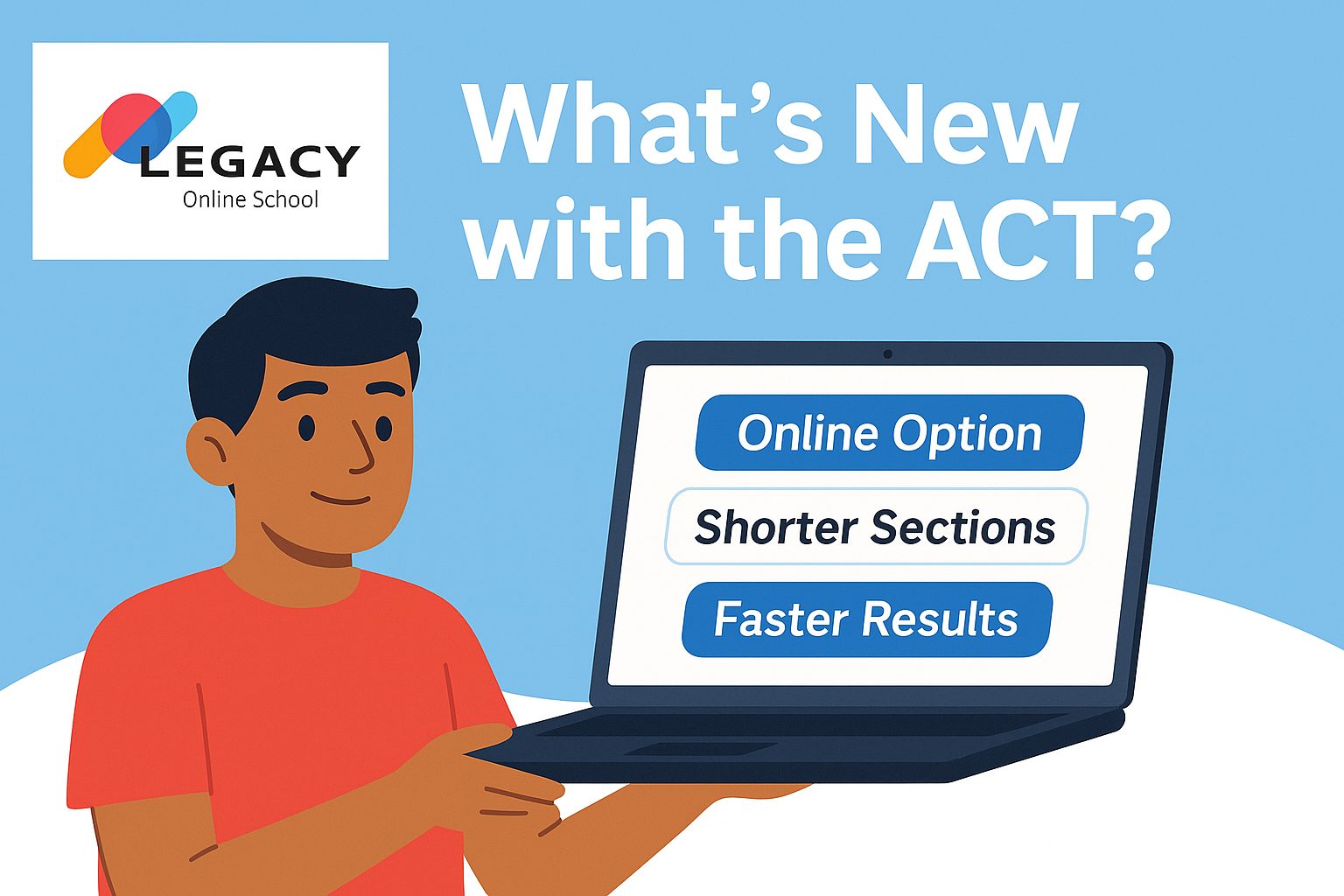
What’s New with the ACT?
ACT vs SAT

Here’s a snapshot of what’s changing—and what’s not:

Element Version of 2024 Version of 2025
Test format Mostly paper Digital expanding in U.S., still paper-optional
Part timing Same Same (English: 45 min, Math: 60, Reading: 35, Science: 35)
Content updates Minor Subtle rebalancing in Reading and Science
Writing (Essay) Officially discontinued in most schools Fully phased out nationally
Superscore policy Optional per college More schools now accept ACT Superscores by default

How to Prepare for Either the ACT or SAT?

Legacy Online School helps students build the confidence and skills they need to succeed on the SAT® and ACT®. If you’re serious about improving your score, we’re here to guide you every step of the way.

Regardless of the test, prep smart:

  • Use official websites to see how the test works
  • Use score calculators to track growth (e.g., UWorld, Bluebook)
  • Focus on timing drills—most mistakes happen under pressure
  • Choose a structured plan like those from Legacy Online School or Khan Academy (SAT)
  • Target your weakest section first, then balance across all areas

“I got a 1560 and my biggest piece of advice is to take practice test after practice test. I didn’t sign up for a tutoring service or online program. Instead, I printed out loads of practice tests that I found online (from the past decade or so) and took each, went through all of the problems, understanding why I got certain questions right and why I got certain questions wrong. I then underlined and highlighted patterns that I noticed through the sections and made myself a ‘guide’ with tips and valuable content. I’d recommend this method, but, of course, everyone learns differently”

— u/Remarkable_Air_769, Reddit

Try 3 Live Classes for Free
Try for free!

Top Tips from Our Expert


  • Look at what you’re good at and choose the test where you can do better
  • Take both a full ACT and SAT practice test before deciding which to commit to
  • Legacy Online School offers test-match consultations to help you prep and improve on the best path for you

ACT vs SAT

Alyssa Mendoza, AP Coordinator and College Prep Specialist

Sources: College Board, ACT, Reddit

Related posts:

1 Month SAT Study Plan: Your Guide to Study for the SAT 1 Month SAT Study Plan: Your Guide to Study for the SAT
1 Month SAT Study Plan: Your Guide to Study for the SAT
1260 SAT Score Meaning: Is This a Good SAT Score & Percentile? 1260 SAT Score Meaning: Is This a Good SAT Score & Percentile?
1260 SAT Score Meaning: Is This a Good SAT Score & Percentile?
1080 SAT Score: Good? GPA, Colleges That Accept a 1080 1080 SAT Score: Good? GPA, Colleges That Accept a 1080
1080 SAT Score: Good? GPA, Colleges That Accept a 1080
1320 SAT Score: Percentile, Colleges Admissions & Top Colleges 1320 SAT Score: Percentile, Colleges Admissions & Top Colleges
1320 SAT Score: Percentile, Colleges Admissions & Top Colleges
1300 SAT Score Explained: Is 1300 a Good SAT Score for College Admissions? 1300 SAT Score Explained: Is 1300 a Good SAT Score for College Admissions?
1300 SAT Score Explained: Is 1300 a Good SAT Score for College Admissions?
Is 1370 a Good SAT Score? Percentile, College Admissions, and What To Know Is 1370 a Good SAT Score? Percentile, College Admissions, and What To Know
Is 1370 a Good SAT Score? Percentile, College Admissions, and What To Know

ACT vs SAT

Unlock 20% Off 🎁 — Start the Quiz

Related posts:

 1 Month SAT Study Plan: Your Guide to Study for the SAT 1 Month SAT Study Plan: Your Guide to Study for the SAT
1 Month SAT Study Plan: Your Guide to Study for the SAT
 1260 SAT Score Meaning: Is This a Good SAT Score & Percentile? 1260 SAT Score Meaning: Is This a Good SAT Score & Percentile?
1260 SAT Score Meaning: Is This a Good SAT Score & Percentile?
 1080 SAT Score: Good? GPA, Colleges That Accept a 1080 1080 SAT Score: Good? GPA, Colleges That Accept a 1080
1080 SAT Score: Good? GPA, Colleges That Accept a 1080
 1320 SAT Score: Percentile, Colleges Admissions & Top Colleges 1320 SAT Score: Percentile, Colleges Admissions & Top Colleges
1320 SAT Score: Percentile, Colleges Admissions & Top Colleges
 1300 SAT Score Explained: Is 1300 a Good SAT Score for College Admissions? 1300 SAT Score Explained: Is 1300 a Good SAT Score for College Admissions?
1300 SAT Score Explained: Is 1300 a Good SAT Score for College Admissions?
 Is 1370 a Good SAT Score? Percentile, College Admissions, and What To Know Is 1370 a Good SAT Score? Percentile, College Admissions, and What To Know
Is 1370 a Good SAT Score? Percentile, College Admissions, and What To Know

FAQ

Q: What is the primary comparison between the ACT and SAT?
A: The SAT and ACT are both college admissions tests accepted by most U.S. universities. The SAT tends to emphasize reasoning, evidence-based reading, and math with some advanced algebra, while the ACT includes a faster pace, a science section, and more direct questions. Choosing between them often comes down to personal test-taking style.
Q: How is the ACT score calculated compared to the SAT score?
A: The ACT is scored on a scale of 1-36, averaging four sections: English, Math, Reading, and Science. The SAT is scored on a scale of 400-1600, combining Math (200-800) and Evidence-Based Reading and Writing (200-800). Neither test penalizes for wrong answers.
Q: Should I take the SAT or ACT for college admissions?
A: Both tests are equally accepted by colleges, so the better choice depends on your strengths. If you’re better with data interpretation and tight timing, the ACT may suit you. If you prefer more time per question and excel in reading comprehension and algebra, try the SAT.
Q: What are the key differences in test sections between the SAT and ACT?
A: The ACT includes English, Math, Reading, and Science, with an optional Essay. The SAT includes Reading, Writing and Language, and Math, now offered in digital format without a Science section. SAT math allows calculators throughout; ACT has a broader mix of topics, including trigonometry.
Q: Can I take the ACT multiple times, and will it help my score?
A: Yes. You can take the ACT up to 12 times. Most students improve with each retake, especially if they review their score report and target weak areas. Colleges generally consider your best composite score or even superscore your highest section scores.
Q: What are some pros and cons of taking the SAT vs. ACT?
A: The SAT gives you more time per question and focuses on problem-solving. The ACT is faster-paced but more straightforward, with a science section that tests data analysis, not science content. Some students find the ACT easier to finish but harder to master. The SAT is now fully digital, which can affect how you approach timing and practice.
Q: What is the significance of taking a full-length practice test for the SAT or ACT?
A: Full-length practice tests are the best way to measure your endurance, pacing, and readiness. They show how you'll perform under real conditions and help identify your most time-consuming question types. Use them to fine-tune your prep and simulate test-day pressure.
Q: How do SAT and ACT test dates differ?
A: The SAT is offered seven times per year in the U.S., with specific dates for digital and paper-based tests. The ACT is offered six to seven times, often alternating months. Deadlines and score release schedules differ, so check both calendars when planning your prep timeline.
Q: What should I consider when deciding whether to take the ACT or SAT?
A: Consider your academic strengths, practice test scores, timing preferences, and whether you’re applying to schools that superscore one or both tests. Try taking a diagnostic version of each. Whichever test feels more natural is likely the one you'll perform better on—and that’s what matters most to admissions.
avatar

About author

Co-Founder & Adviser
Ask a question

Vasilii Kiselev is a leading expert in online and virtual education and serves as a co-founder and advisor at Legacy Online School. He directs the development of dynamic, interactive, and accessible virtual learning environments, with a focus that spans K-12 education and homeschooling alternatives.

His approach integrates advanced technology to deliver high-quality, flexible learning experiences. Vasilii views Legacy Online School as a platform for empowering students and equipping them with essential digital skills for the future. His work has been featured on platforms such as eLearning Industry and Forbes Councils.