Key takeaways
Understanding the ACT score chart is essential for students aiming for college admissions, as it provides a clear picture of their performance across different sections of the test. This article outlines how to interpret the ACT score chart, calculate scores, and what constitutes a competitive ACT score, enabling students to set realistic goals for their college applications.
- The national average composite score for the ACT typically ranges from 20 to 26 (ACT, 2023).
- Students should use the ACT score chart to identify their strengths and weaknesses in specific sections, guiding their study efforts effectively.
- A composite score of 30-36 is generally considered very competitive for elite colleges, while scores of 20-29 may suffice for many state schools.
- Understanding the conversion from raw scores to scale scores helps students gauge their preparedness and adjust their study plans accordingly.
Contents
The ACT test is an important part of US college entrances. Knowing the ACT score chart is fundamental for the students that would like to determine their test scores precisely, and evaluate if their scores are competitive.
This article we will dive into the ACT score chart, how to calculate the ACT score, what is a good ACT score, and the importance of these scores in college admissions.

What Is Considered a Good ACT Score?
A good ACT score is often defined in relation to average ACT scores. The national average composite score for the ACT typically hovers around 20-26. Therefore, scores above this average, such as 24 or higher, are generally considered good ACT scores.
Comparing Your Score to National Averages
In order to gauge how strong a student’s ACT test score is, its performance must be compared to national averages that are between scores 20 and 26. Students get to measure their position with regard to their peers from this comparison.
For instance, if the composite score of students is 29, they will be better than the national average, improving application profile. This comparative score is one which is often taken into consideration by the colleges while they scrutinize applications since it adds context to the students’ academic performance.
Students can also evaluate their results using score percentiles, which show how their ACT performance compares with other test-takers.
Factors Influencing What is Considered a Good ACT® Score

Several factors influence the determination of a good ACT score and here are they listed below:
- Competitiveness of the institution
- Applicant pool
- Program’s special requirements.
Furthermore, there are colleges which practice holistic admissions which mean that test scores only are one aspect of a student’s profile in terms of GPA, extra curricular activities and personal statements.
Legacy Online School helps students build the confidence and skills they need to succeed on the SAT® and ACT®. All lessons are delivered live online, with real-time support and feedback from qualified instructors who are fully invested in your progress. For families considering enrollment, you can review tuition & fees to find a plan that fits your budget. If you’re serious about improving your score, we’re here to guide you every step of the way.
What Is the Score Range for the ACT® Test?
The ACT score ranges run from 1 to 36, covering all possible composite scores. This score scale reflects performance and also helps students understand their relative standing among test-takers.
Average ACT® Scores and Their Implications
The average ACT scores feed students with important context when assessing their performance. As indicated above, the national average score is somewhere at 20.6 and many of the students target to surpass this mark.
Knowing of the implications of the average ACT score can prepare students to make informed decisions with regard to applying for colleges and preparing for retakes if they ever become necessary.
What Different Score Ranges Mean for College Admissions
Different score ranges can have a major impact upon college admissions. For example, students with composite scores of 30-36 are usually considered to be very competitive applicants; 20-29 points can be sufficient to obtain a place in many state schools.
However, students who want to achieve elite institutions often require to hit the higher scores. Knowing what various score ranges imply with regard to college admissions can help students plan their studies realistically and make their college admission more likely.
What Is the ACT Score Chart and How To Use It?

The ACT score chart is an important tool which students can use to understand their results from the ACT test. This chart gives a detailed breakdown of scores between 1 and 36 which is the scale of scoring achieved on ACT. If you’re new to the exam, you might first be wondering: what does ACT stand for? Understanding the meaning behind the acronym can give helpful context before diving into score interpretation. The score chart enables students to see how they have performed in various areas in the test- such as English, Math, Reading and Science.
All of these sections are accompanied by their raw scores, which are then standardized and converted to scale scores which appear on the score report. The ACT score chart is important to students to not only tell them their overall performance, but also their section scores and subscores which can tell them their strong and weak academic skills.
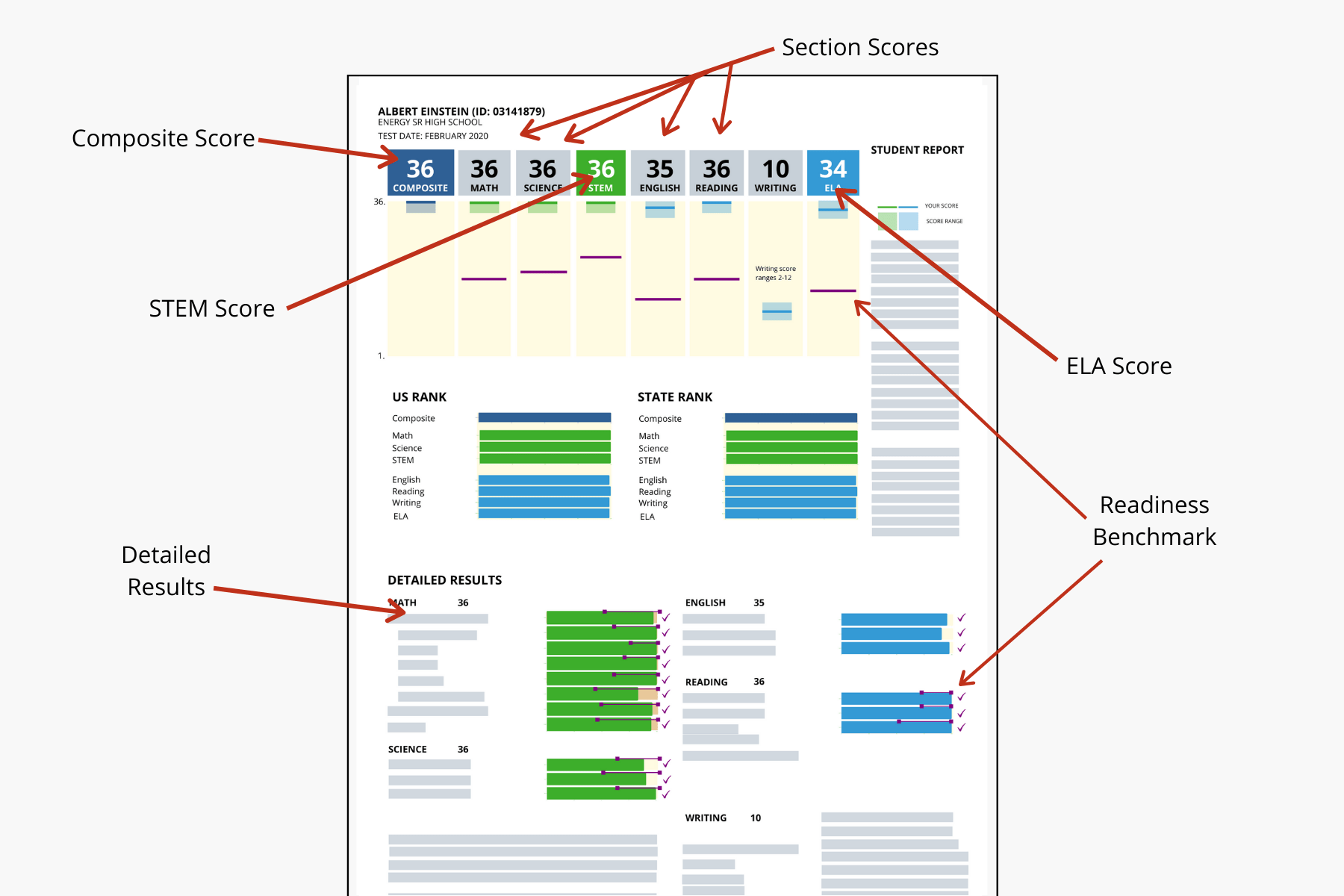
How to Read the ACT® Score Chart
Understanding the conversion of raw scores to scale scores is understanding the reading of the ACT score chart and ACT websites provides students with information on that.
For instance if a student gets a certain number of questions in the English section right the chart will help them visualize where that translates into in the scale.
A grid which indicates the number of correct answers required to earn the desired scale scores tends to be present in the ACT score chart, which students can refer to in order to compute their ACT score. Students will be able to determine their preparedness towards the college level course and be able to make informed choices in their college applications from the identification of their scores in each section.
Here is how students can read their score chart shown below:
Importance of the ACT® Score Chart for Students
ACT score chart is important for students who intend to sit in for the ACT for college admission. With the use of the chart, the student can determine his or her target score for the ACT exam based on the educational goals and average ACT score of colleges to which he or she aims to apply. Knowing their stand on the score range enables students to give realistic targets to make improvement.
Besides, the ACT score chart helps keep track of the progressions over the time so that the students are able to increase the scores with the deep study and preparation plan. Students who need to adjust their plans before test day should also know how to cancel ACT registration — understanding the cancellation process can save time and fees if circumstances change.
How Do You Calculate Your ACT® Score?
“Understanding how raw scores convert into scaled ACT scores is an important part of effective test prep. In our ACT prep programs at Legacy Online School, we encourage students to take the ACT under timed conditions, including optional sections like the writing test, and then analyze their results to see how each section contributes to their overall performance and college readiness”
Calculation of ACT score starts from calculating a student’s raw score for every section of the test. A raw score is just a number of questions he or she has answered correctly on each section.
For instance, if a student sat for the ACT exam and got 25 questions right in the Math section leaving 60 questions, his or her raw score for the Math section would be 25. Many students will use an ACT score calculator or converter that makes it easy to convert raw scores into scale scores to help them out.
This conversion is important because with this conversion the students get to see how their performance works in accordance with the projected expectations of colleges and universities. Students can use the Albert.io calculator to check their own possible score now!
Conversion from Raw Scores to Scale Scores
Conversion process from raw scores to scale scores is not equal for all sections of the ACT.
There is a conversion chart for each section, often called an ACT scoring chart, showing how correct answers translate into scaled scores. For example, students reviewing the Math section often refer to an ACT math score chart to see how raw math answers convert into the final scaled score. For example, in case, the students wish to compute the ACT score in the Reading section, students would then refer to the ACT raw score conversion grid to retrieve their raw scores.
This grid actually helps students to know the number of right answers required by them to earn a target score, for example, a 30 or a 33. Learning how to move around this conversion process can really improve their understanding of their performance on the ACT test. Students who took both exams may also find it useful to explore ACT to SAT conversion charts, which help translate ACT scores into their SAT equivalents for colleges that accept either.
Understanding Score Ranges for Each Section
Each section (English, Math, Reading, Science): Scores range from 1 to 36.
Composite Score: This is the average of your four section scores, rounded to the nearest whole number.
Writing Section: Scores range from 2 to 12 (a sum of two raters’ scores), with a 1-6 scale for each essay.
For instance, the English part measures grammar and use, and the Math section – problem solving and quantitative reasoning abilities.
What is important for students to know is the average score that can be achieved in these sections so that they can measure their results.
For example, an English mark of 31 would be good but a score of 14 could tell of improvements. Studying the way students score falls into the overall score range for each section helps them plan their study goals effectively.
Legacy Online School provides students with more information on ACT scoring on their blog. Check it out for more information on ACT and SAT prep.
|
Top Tips from Our Expert
|
Maya Robinson, ACT Scoring and College Readiness Specialist
Sources: ACT.org